
Table of Contents
1. What is Command and Control (C2)?
Command and control (C2) is the communication channel a threat actor uses to remotely operate the systems they have compromised. Once malware lands on a target machine it is essentially inert. It cannot steal, spread, or cause damage until it receives instructions, and the C2 channel is what carries those instructions in and sends stolen data back out. In short, C2 is the nervous system that connects the attacker's intent to the victim's machine.
Every C2 exchange runs in two directions. Outbound traffic is the implant asking, in effect, "what should I do?" Inbound traffic is the operator answering with tasks and pulling back the results. A C2 server is the endpoint on the attacker side that issues those tasks, and a C2 channel is the transport that carries them, whether that is HTTP, DNS, a messaging app, or a public blockchain.
C2 sits at the center of the intrusion lifecycle, corresponding to the Command and Control tactic (TA0011) in the MITRE ATT&CK framework. After initial access and execution, almost every meaningful action an attacker takes, including reconnaissance, credential theft, lateral movement, and data exfiltration, depends on a working C2 channel. This is also why C2 is one of the most valuable things to detect: cut the channel, and the malware on the host goes deaf and mute.
Key Takeaway
Malware without a command and control channel is just code sitting on a disk. C2 is what turns a single infected machine into a controllable asset, which is exactly why detecting and disrupting C2 traffic is so important to defenders.
2. The C2 Lifecycle
Whatever transport an attacker chooses, a C2 channel carries the same six logical steps. Understanding this lifecycle makes every individual technique in the rest of this guide easier to place.
- Infection: the implant or payload lands and executes on the victim host.
- Check-in (beaconing): the implant contacts the C2 server to announce that it is alive and ready for instructions.
- Tasking: the operator sends commands, such as run this process, locate that file, or move to this host.
- Execution: the implant carries out the order on the compromised machine.
- Exfiltration: stolen files, credentials, cookies, or other data flow back through the channel.
- Maintain: the implant updates itself, re-establishes the channel if it drops, and keeps the line open for future tasking.
Beaconing deserves special attention because it is where many C2 channels betray themselves. A naive implant that checks in every 60 seconds on the dot produces a machine-perfect rhythm that no human-driven application would generate. To hide this, modern implants add jitter (a random variation in the check-in interval) and long sleep times between beacons. These two settings are a constant tug-of-war: more jitter and longer sleeps mean better stealth but slower control.
3. Why C2 Methods Keep Evolving
Every C2 method leaves a fingerprint. It might be an IP address, a domain name, a TLS certificate, or a recognizable traffic pattern. Defenders learn that fingerprint and block it, and attackers respond by inventing a new way to hide. This is the arms race that drives the entire history of C2.
The direction of that arms race never really changes. Across three decades, attackers have moved consistently toward three goals:
- Blend into trusted traffic so that C2 looks like normal, expected activity.
- Remove single points of failure so that no single seizure or sinkhole can kill the channel.
- Encrypt and reshape traffic so that signature-based detection fails.
Hold these three goals in mind and every technique below stops looking like a random catalog and starts looking like a logical progression. Each new method is a direct answer to whatever pressure defenders applied to the last one.
4. Classic C2 Protocols
The foundations of C2 are built on the same protocols that run the legitimate internet. They are old, but they remain in heavy use because they are simple, reliable, and allowed out of almost every network.
HTTP and HTTPS Beaconing
The most common C2 transport by far. The implant sends periodic web requests to the C2 server asking for commands, then posts results back, all over ports 80 and 443. HTTPS encrypts the content so that anyone inspecting the traffic sees only an opaque TLS session.
The logic: web traffic is everywhere and is allowed outbound from nearly every network. Hiding C2 inside HTTP is hiding a tree in a forest, and TLS blinds content inspection. This is the channel used by Emotet, QakBot, IcedID, and nearly every Cobalt Strike Beacon.
DNS Tunneling
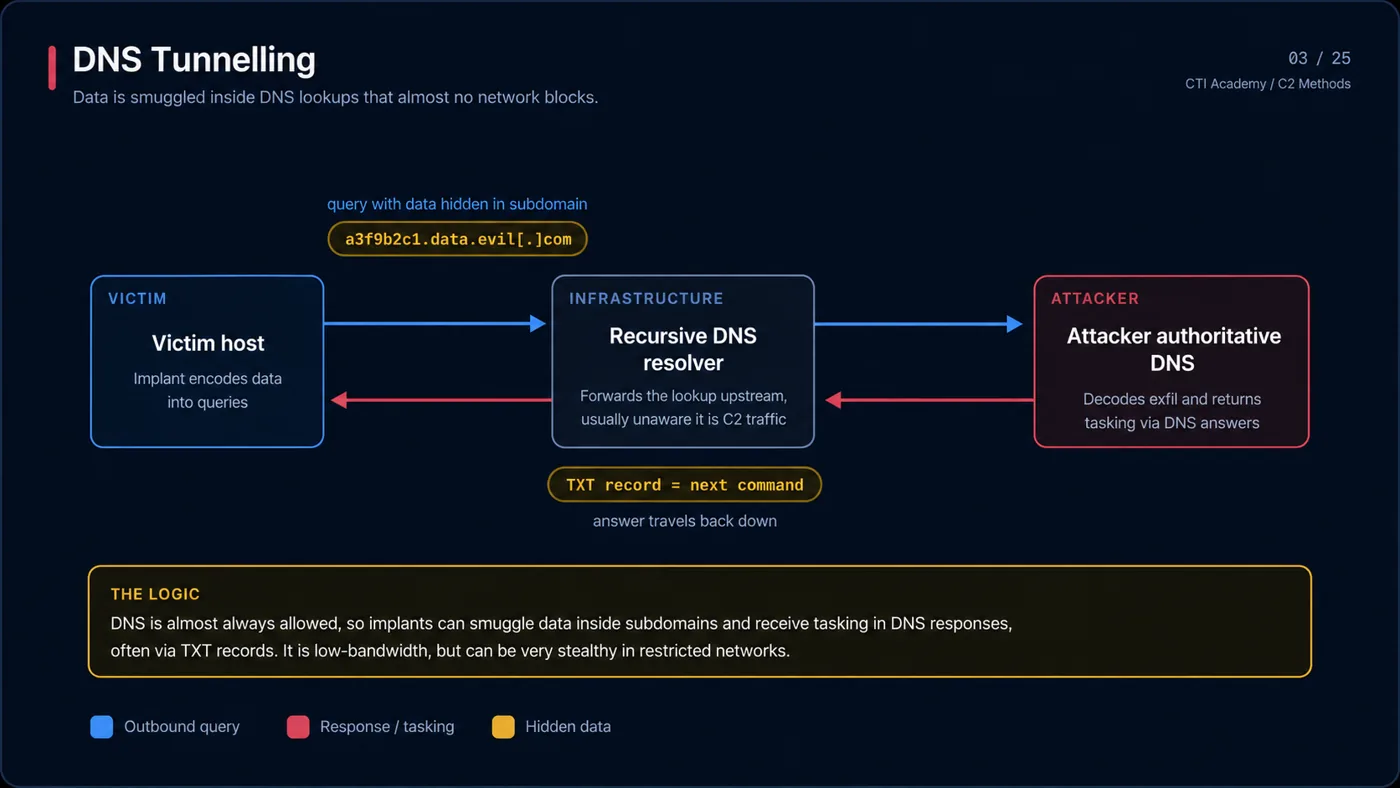
DNS-based C2 encodes data into the subdomain portion of a DNS query, for example encodeddata.attacker[.]com, and receives commands back inside TXT or A records. Every lookup quietly carries a hidden message.
The logic: DNS is the phone book of the internet. It is almost never blocked and is frequently not logged, so even in heavily locked-down networks where direct outbound connections fail, name resolution usually still works. The technique is slow but extremely stealthy. The SUNBURST backdoor used in the SolarWinds compromise, attributed to APT29, used DNS subdomains of avsvmcloud[.]com as a first-stage channel.
ICMP Tunneling
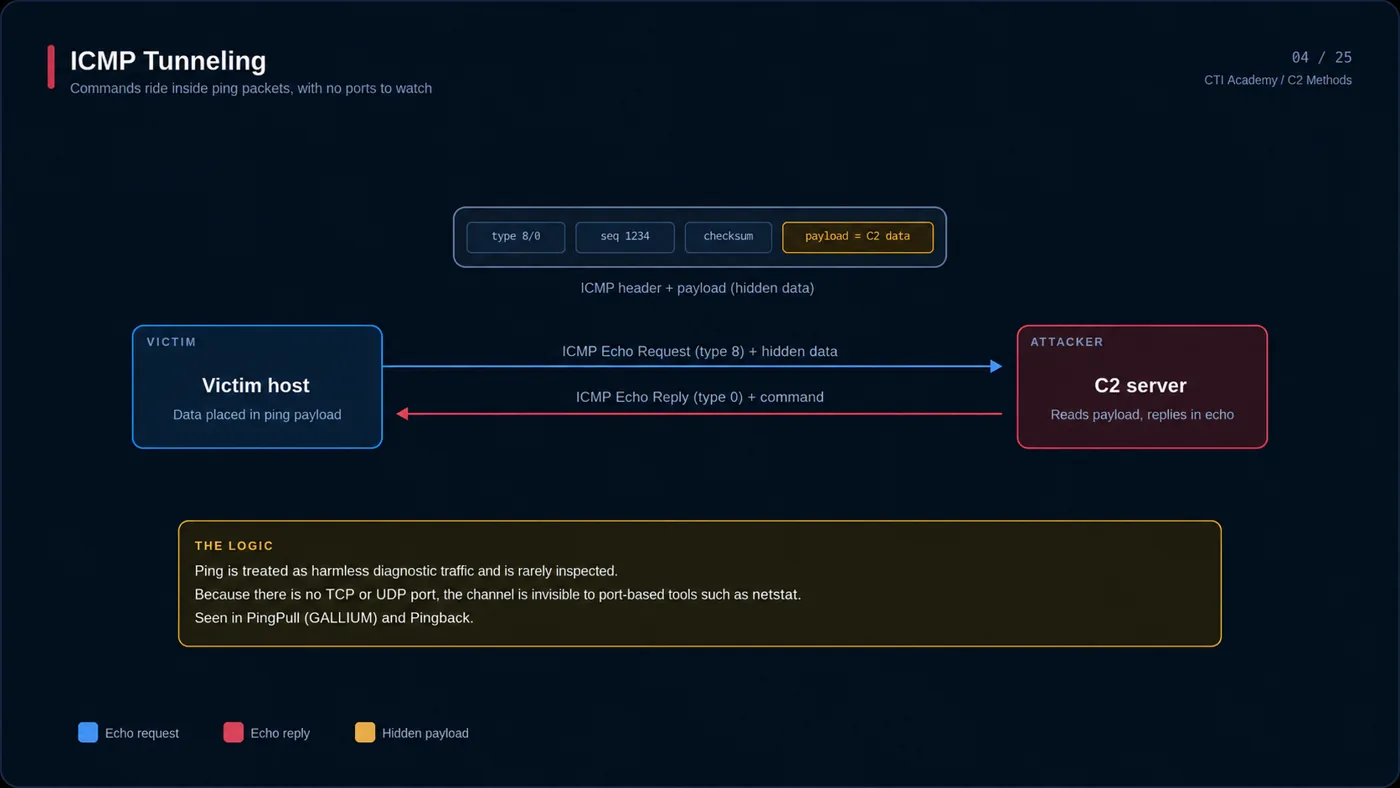
ICMP-based C2 hides data inside the payload or sequence fields of ICMP echo (ping) packets. No TCP or UDP port is ever opened.
The logic: ping is treated as harmless diagnostic traffic and is rarely inspected. Because there is no port involved, the channel is invisible to port-based tools. This approach appears in commodity malware such as Pingback and in PingPull, a tool used by the China-linked group GALLIUM against telecom operators.
Raw TCP and UDP Sockets
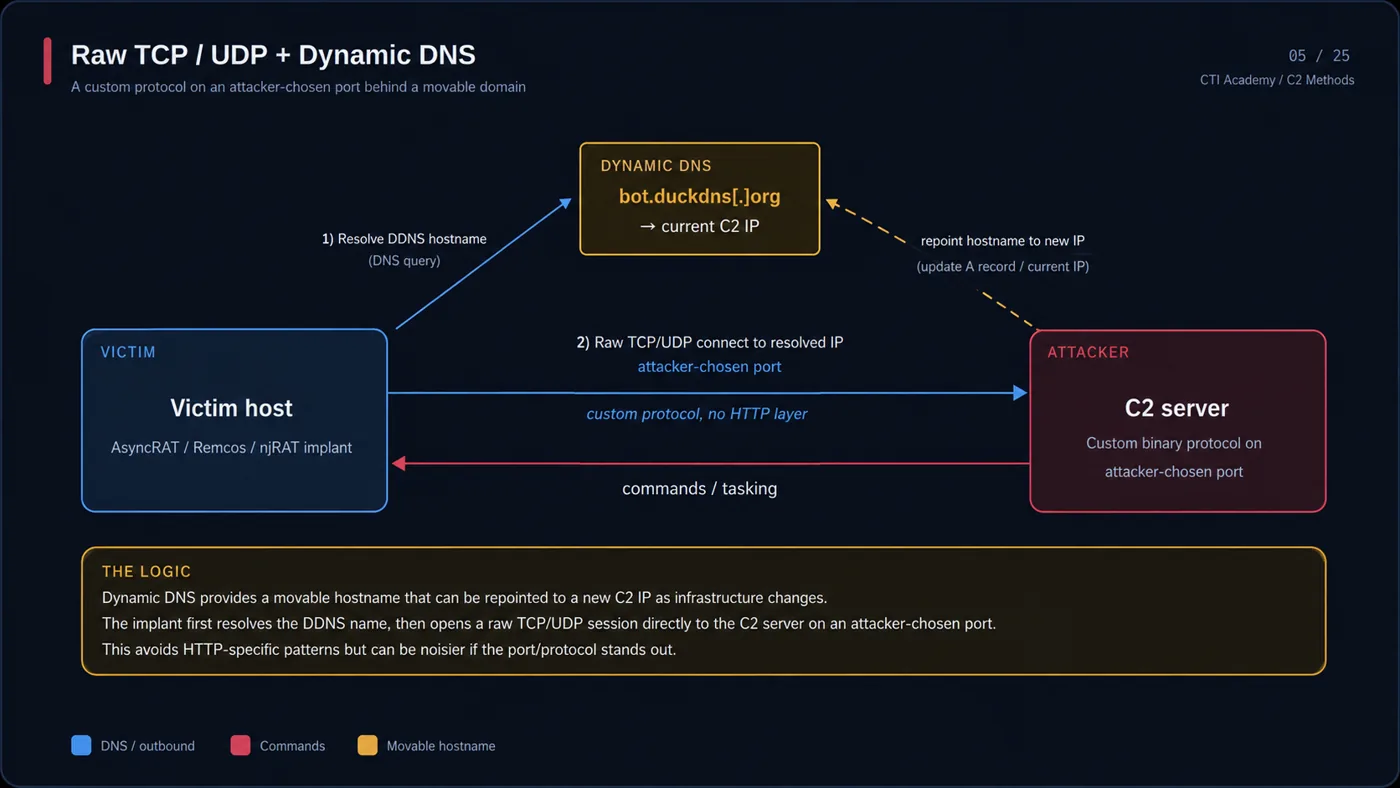
Some malware speaks its own custom binary protocol over an attacker-chosen port, usually paired with a Dynamic DNS (DDNS) domain that can be repointed at will.
The logic: no HTTP overhead and no protocol signatures, total control over the message format, and cheap or free DDNS domains that follow the operator as infrastructure moves. Remote access trojans such as AsyncRAT (default TCP 6606), njRAT (default 1177), Remcos, and DcRAT lean on DDNS providers like DuckDNS and No-IP.
IRC (The Historical Root)
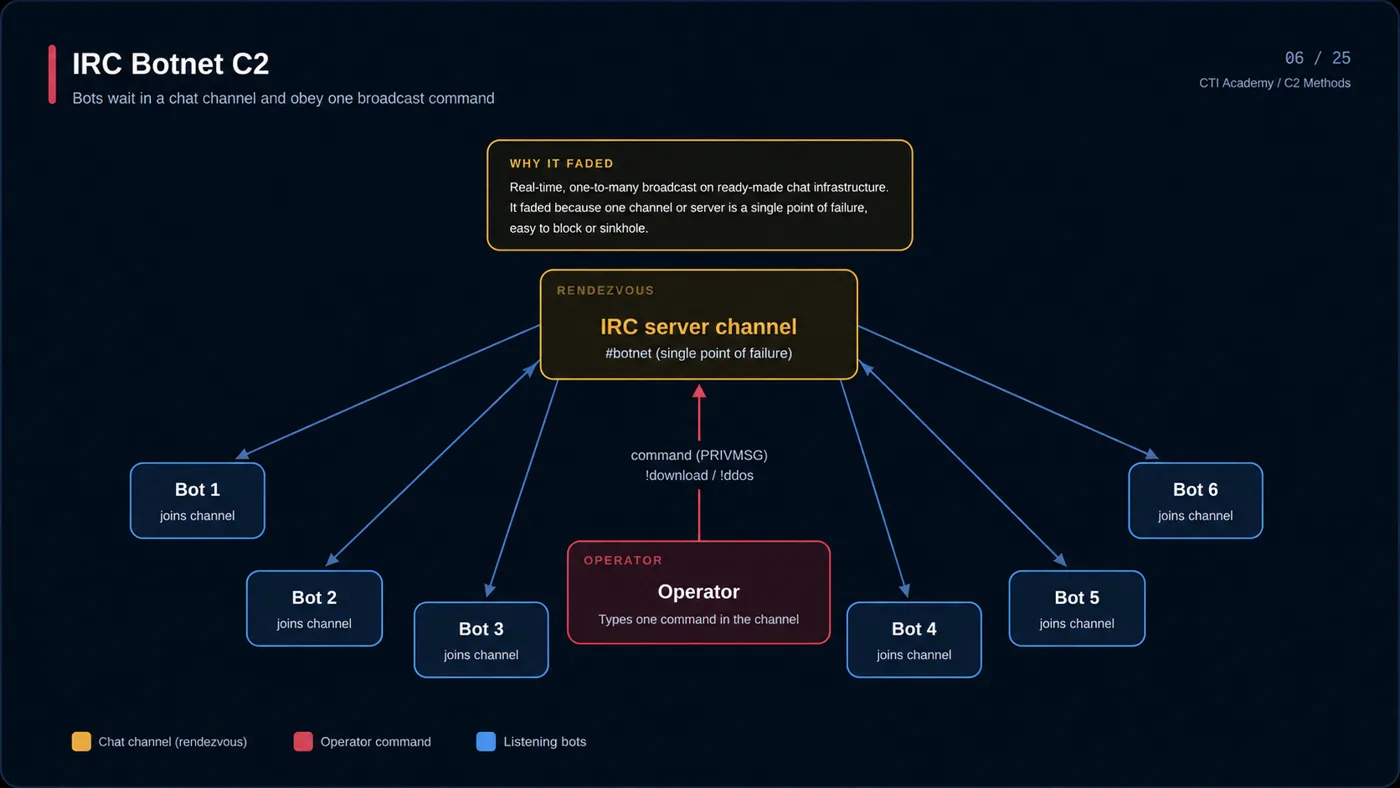
The original botnet control method. Infected bots silently join an IRC channel, the operator types a command into the channel, and every bot obeys at once.
The logic: real-time, one-to-many broadcast built on ready-made chat infrastructure. It faded because a single channel or server is a single point of failure that is easy to block or sinkhole. Early families such as GTBot, SDBot, Agobot, and SpyBot used IRC roughly between 2000 and 2004.
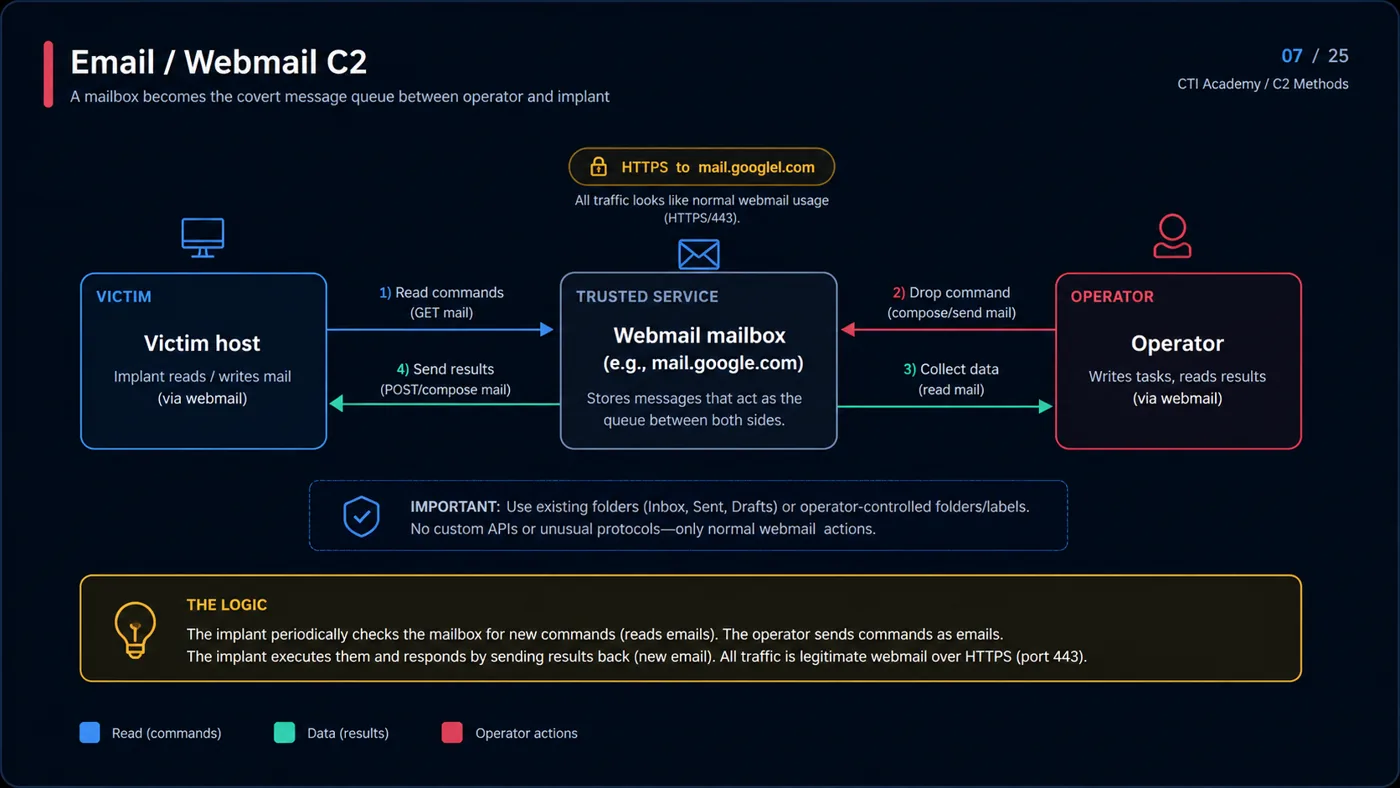
Email-Based C2
Some implants read commands from a webmail inbox or draft folder and send results back as emails or attachments.
The logic: corporate email is always allowed to flow, and webmail over HTTPS blends into normal usage. The mailbox becomes a covert message queue. Turla's ComRAT, for example, used the Gmail web interface to receive tasks and exfiltrate data.
5. Resilience and Evasion Techniques
Once defenders started blocking C2 by IP and domain, attackers built techniques specifically designed to survive takedowns and dodge blocklists.
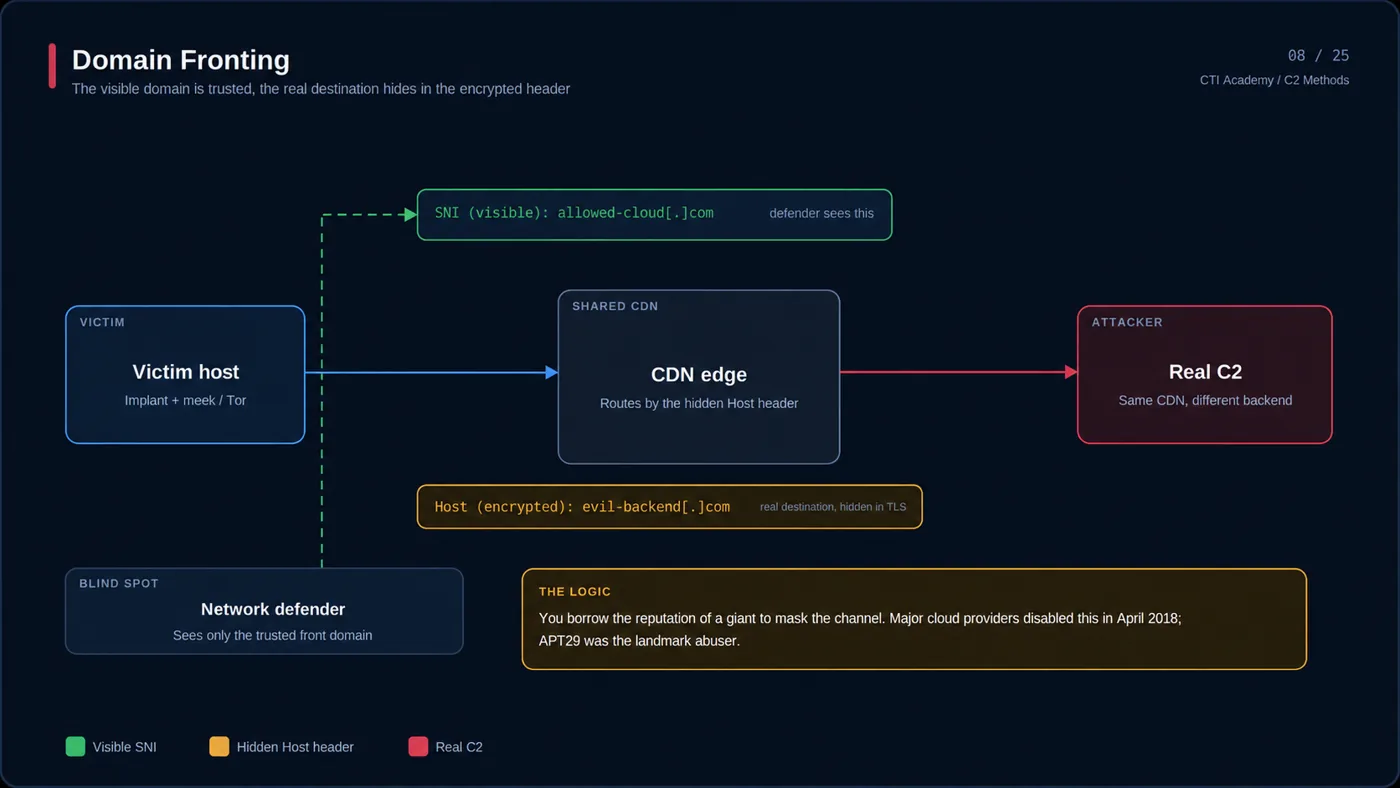
Domain Fronting
Domain fronting splits a connection in two. The visible part, the TLS SNI field, shows an allowed domain such as a major cloud provider. The hidden part, the encrypted HTTP Host header, tells the content delivery network (CDN) to route the traffic to the real C2 hosted on the same network.
The logic: defenders and censors see only the trusted front domain, so the operator effectively borrows the reputation of a giant to mask the channel. APT29 famously paired this with Tor and the meek plugin so traffic appeared to go to Google. Major cloud providers disabled the technique in 2018.
Domain Generation Algorithms (DGA)
A DGA is a secret algorithm shared by the malware and the attacker, seeded with a value such as the current date, that generates hundreds or thousands of pseudo-random domains every day. The attacker registers only one or two of them, and the malware tries them all until one answers.
The logic: you cannot blocklist a domain that does not exist yet. Defenders would have to register or block thousands of domains daily, while the attacker needs just one to connect. Conficker generated up to 50,000 domains per day, and the technique also appears in Necurs, Dridex, and Gameover Zeus.
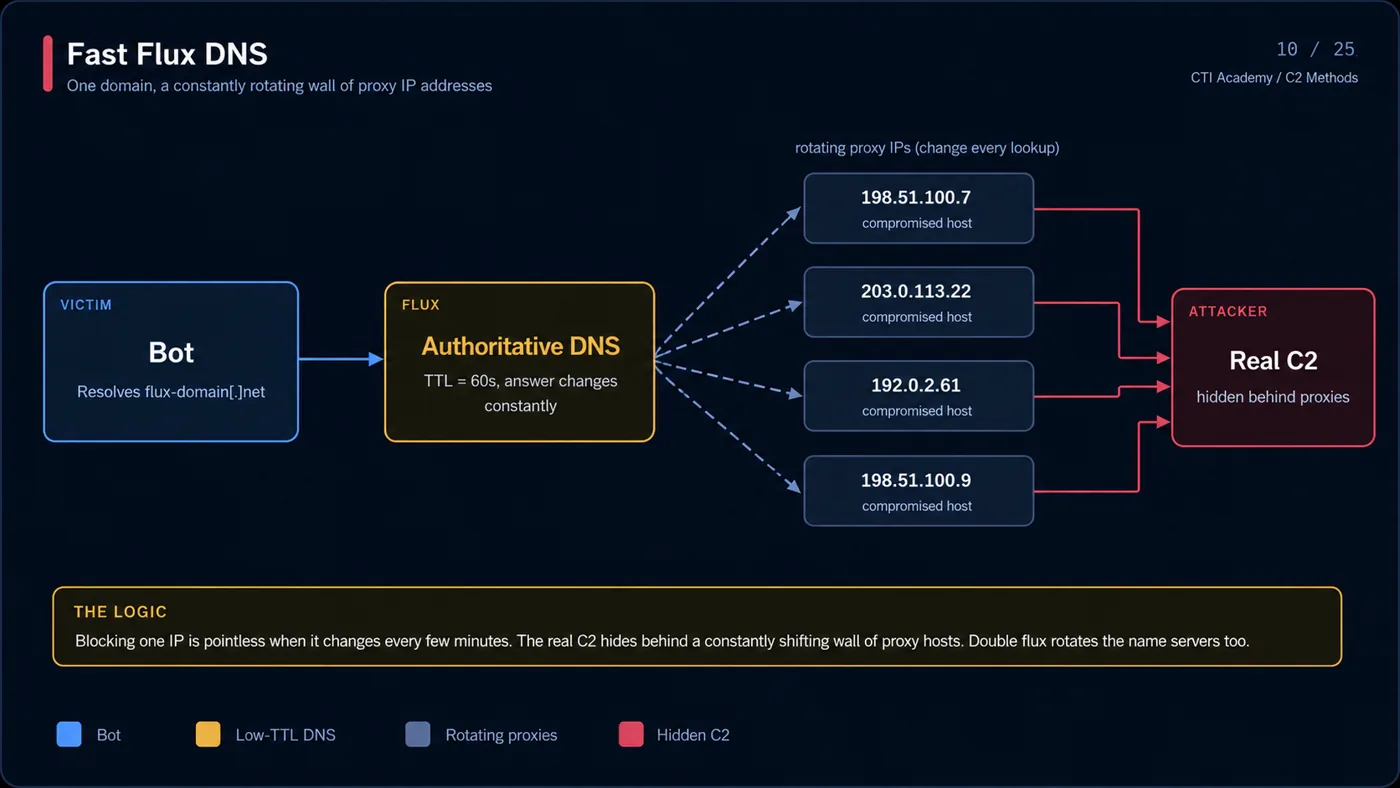
Fast Flux DNS
Fast flux rotates a single domain through many IP addresses using very low TTL records, with compromised hosts acting as disposable proxies. Double flux rotates the name servers as well.
The logic: blocking one IP is pointless when it changes every few minutes, so the real C2 hides behind a constantly shifting wall of proxies. The Asprox botnet and later Gameover Zeus variants both used this approach.
Peer-to-Peer (P2P) C2
In a P2P botnet there is no central server. Each bot holds a list of peers and relays commands and updates to its neighbors in a gossip pattern. The operator injects an order at any node and it propagates across the network.
The logic: with no single server to seize or sinkhole, killing the botnet requires reaching every node. This is the most takedown-resistant of the classic designs. Gameover Zeus survived a 2012 domain seizure and required a coordinated international takedown in 2014.
Tiered Infrastructure
Mature operations layer their infrastructure. Victims only ever talk to disposable Tier 1 proxies, which forward to protected Tier 2 and Tier 3 servers that hold the real controller, with redirectors in between.
The logic: burning a front-line proxy does not expose or kill the real C2, so compartmentalization protects the crown jewels. Emotet, QakBot, and IcedID all ran tiered botnets with upstream servers hidden on bulletproof hosting.
6. Living off Trusted Services
The defining shift in modern C2 is simple to state: stop building your own infrastructure, which gets blocked, and start hiding inside services that every organization trusts and cannot afford to block. This approach is often called living off trusted sites (LoTS), a variant of the broader living-off-the-land pattern.
The reasoning is hard to argue with. You cannot blocklist api.telegram.org or graph.microsoft.com without breaking legitimate business. TLS to these services is trusted and rarely inspected, and the infrastructure is free, reliable, and already on every allowlist. What was once an exotic trick is now mainstream.
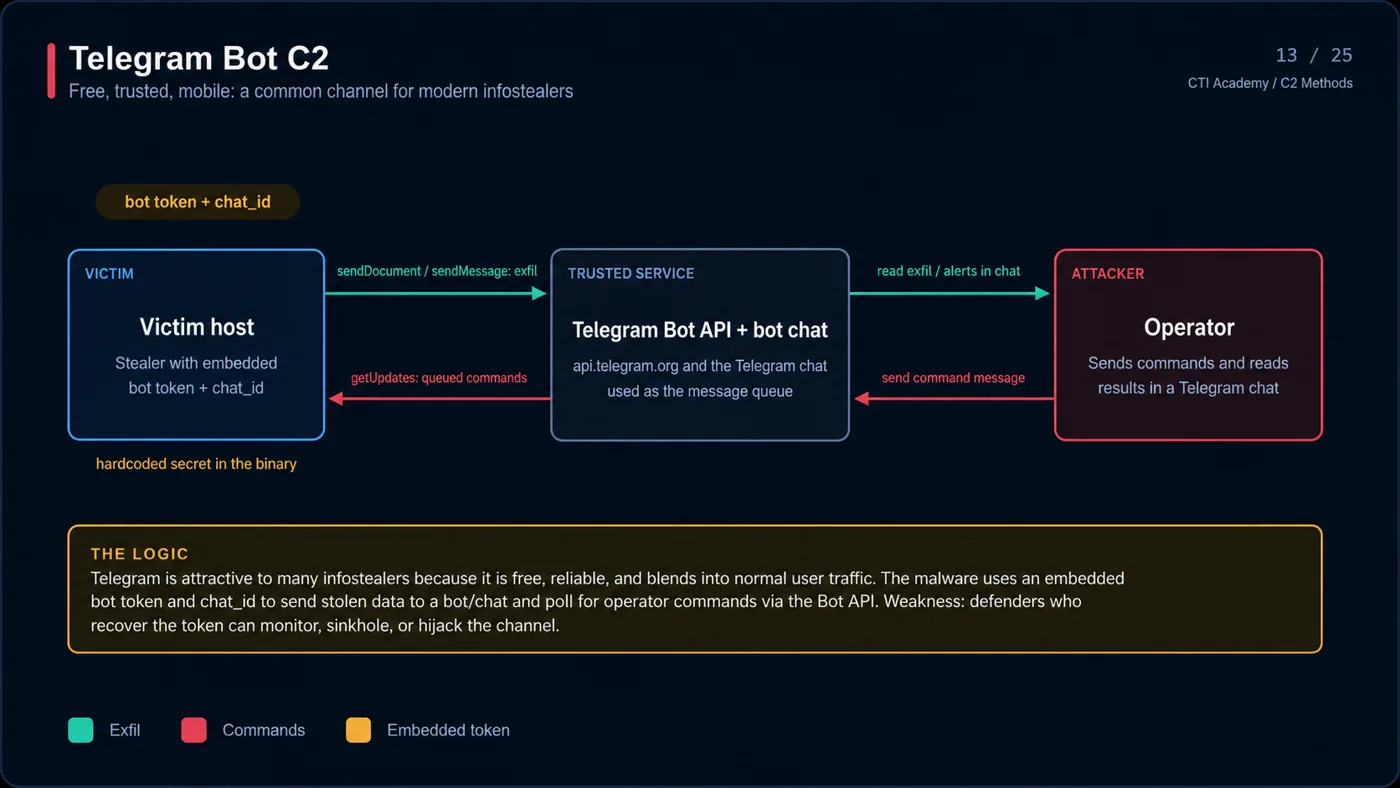
Telegram Bot C2
The malware carries a bot token and a chat ID, then calls the Telegram Bot API to send stolen data and pull down commands. The operator can run the entire thing from a phone.
The logic: free, instant, reliable, mobile, and pointed at a domain every network trusts, which makes it the default channel for modern infostealers such as Lumma, RedLine, Snake Keylogger, and XWorm. The weakness is that the token is baked into the binary, so researchers can extract it and hijack the channel.
Discord (Webhooks and Bots)
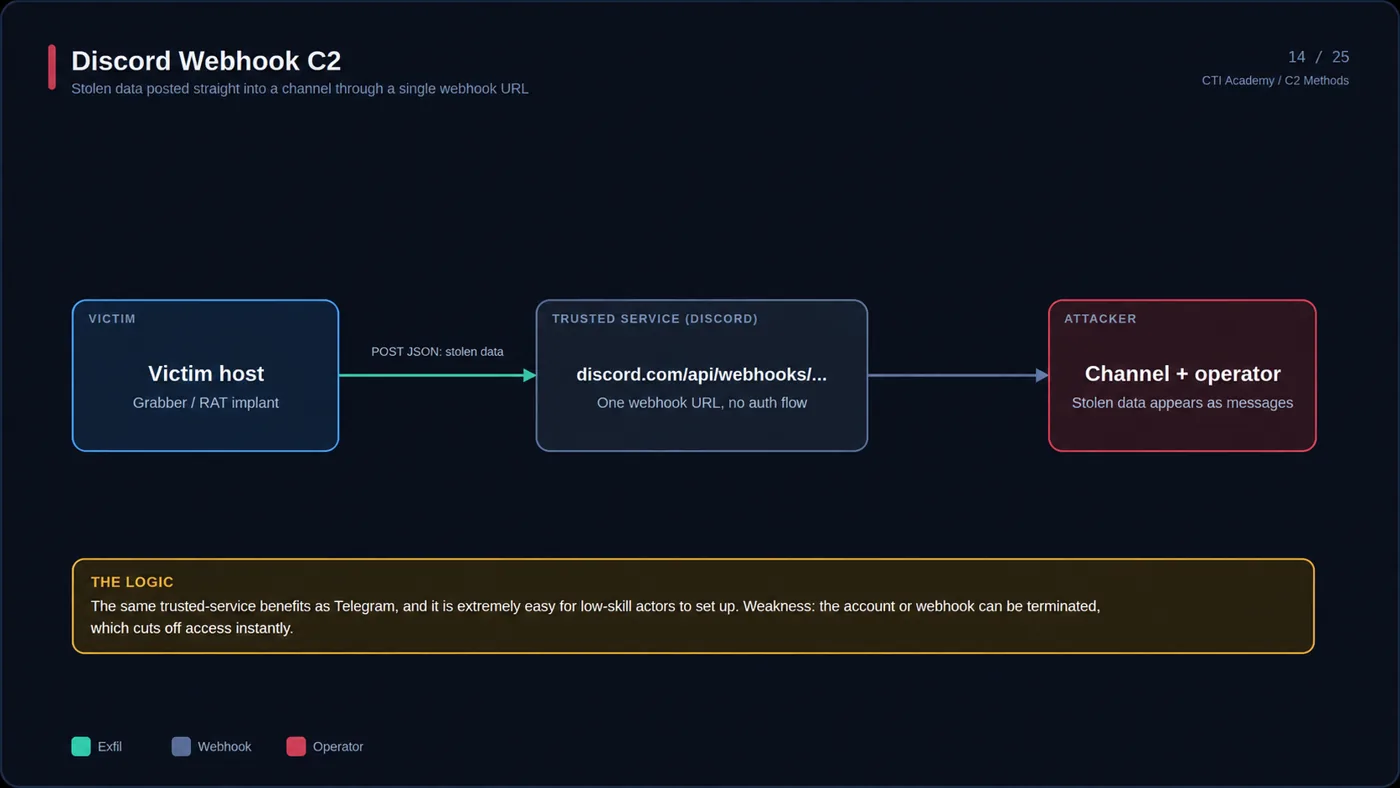
A webhook URL or bot token is hardcoded into the malware. Stolen data is posted straight into a Discord channel, or commands are issued through a bot.
The logic: the same trusted-service benefits as Telegram, and it is extremely easy for low-skill actors to set up. The weakness is that the account or webhook can be terminated, cutting access instantly. KurayStealer and a large family of open-source Discord RATs use this method.
GitHub as a Dead Drop
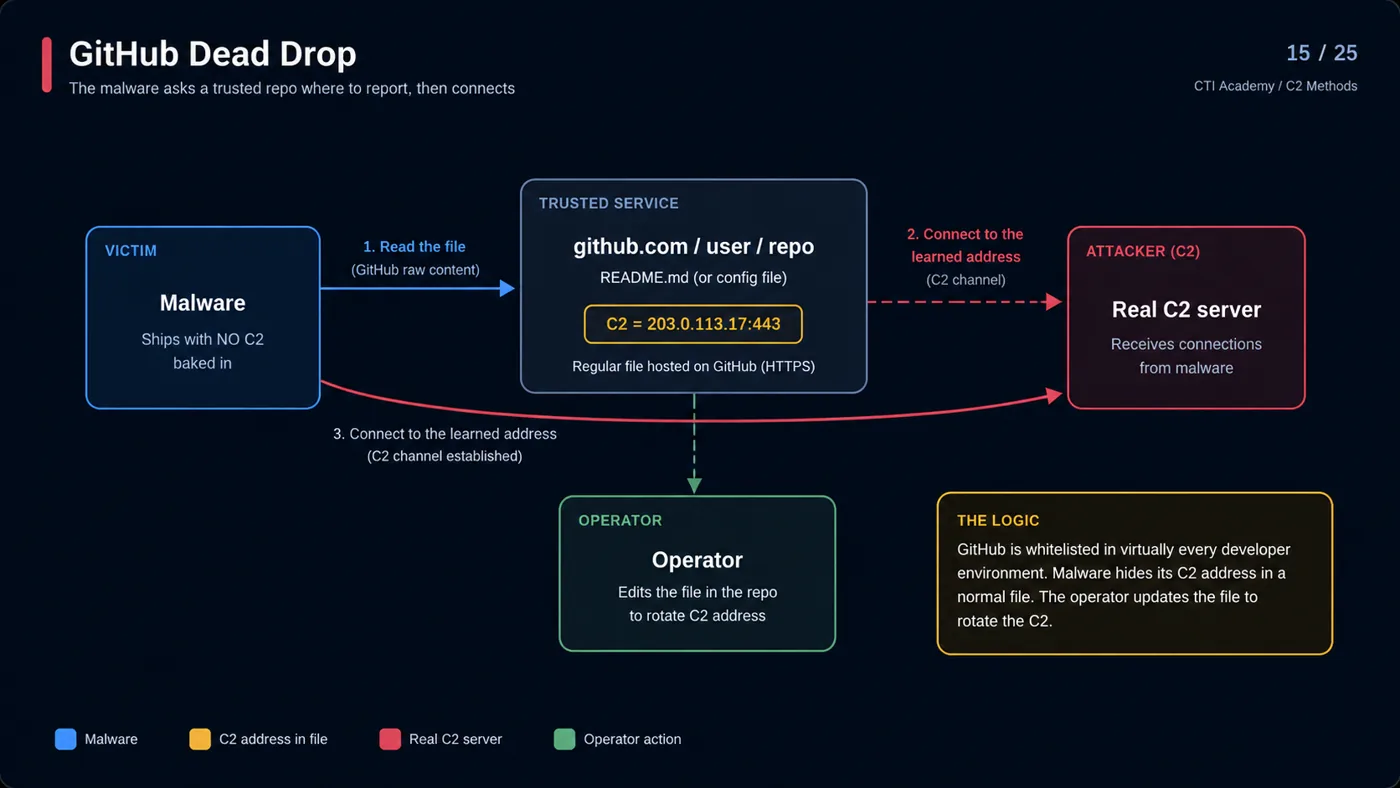
The malware ships with no C2 address inside it. Instead it reads the address from an attacker-controlled file such as a README, a gist, or a commit. To rotate C2, the attacker simply edits the file.
The logic: GitHub is whitelisted in virtually every developer environment, so the malware just asks GitHub where it should report and follows the answer. The Drokbk malware, run by the Iran-linked group Cobalt Mirage, hid its C2 address in a GitHub README.
Google Services as C2
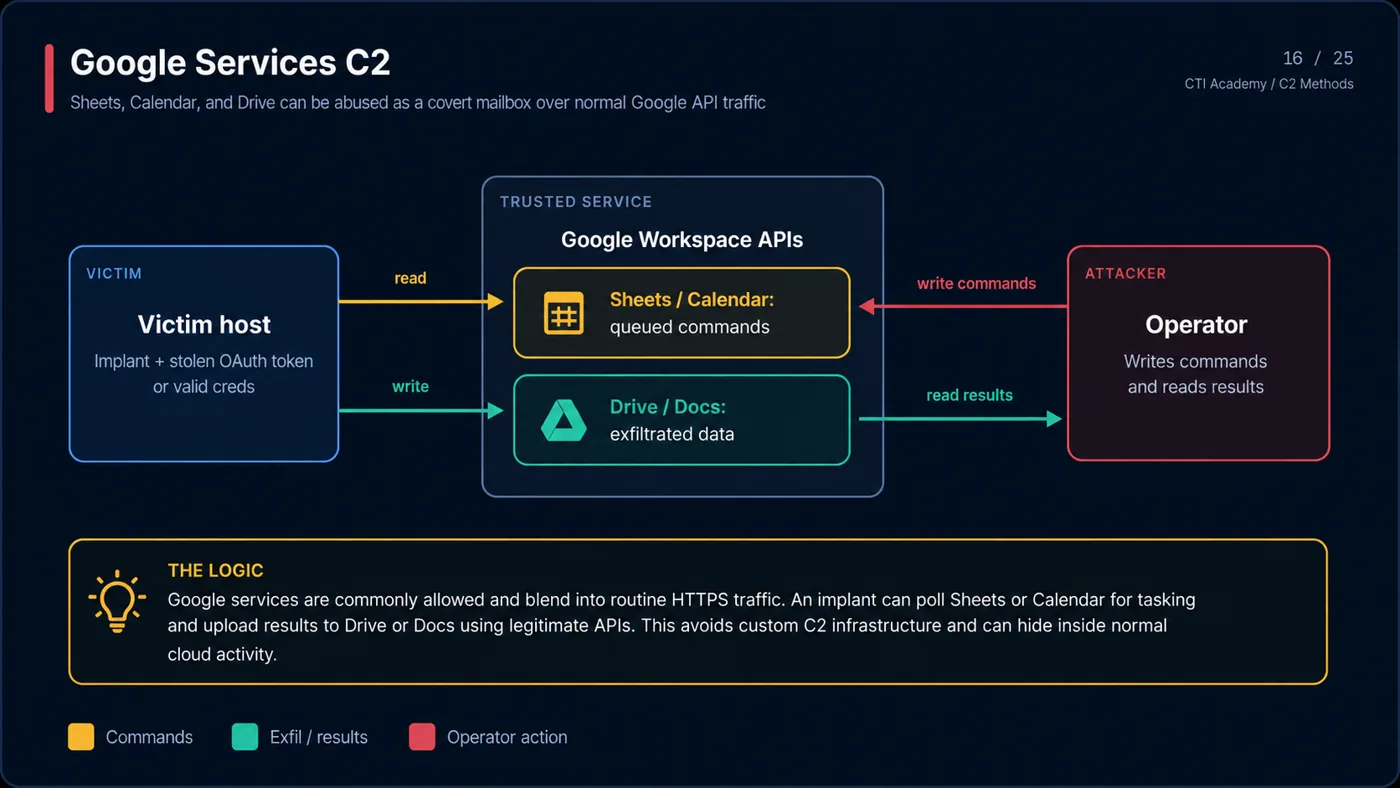
Commands are hidden in Google Sheets cells or Google Calendar event descriptions, stolen data is uploaded to Google Drive, and the malware talks to Google APIs using stolen tokens.
The logic: Google domains are universally trusted and Workspace traffic is normal in every enterprise, so a calendar or a spreadsheet quietly becomes a covert mailbox. APT41 used Google Sheets and Drive through its GC2 tool and later abused Google Calendar in the TOUGHPROGRESS campaign.
Microsoft Graph, OneDrive, and Teams
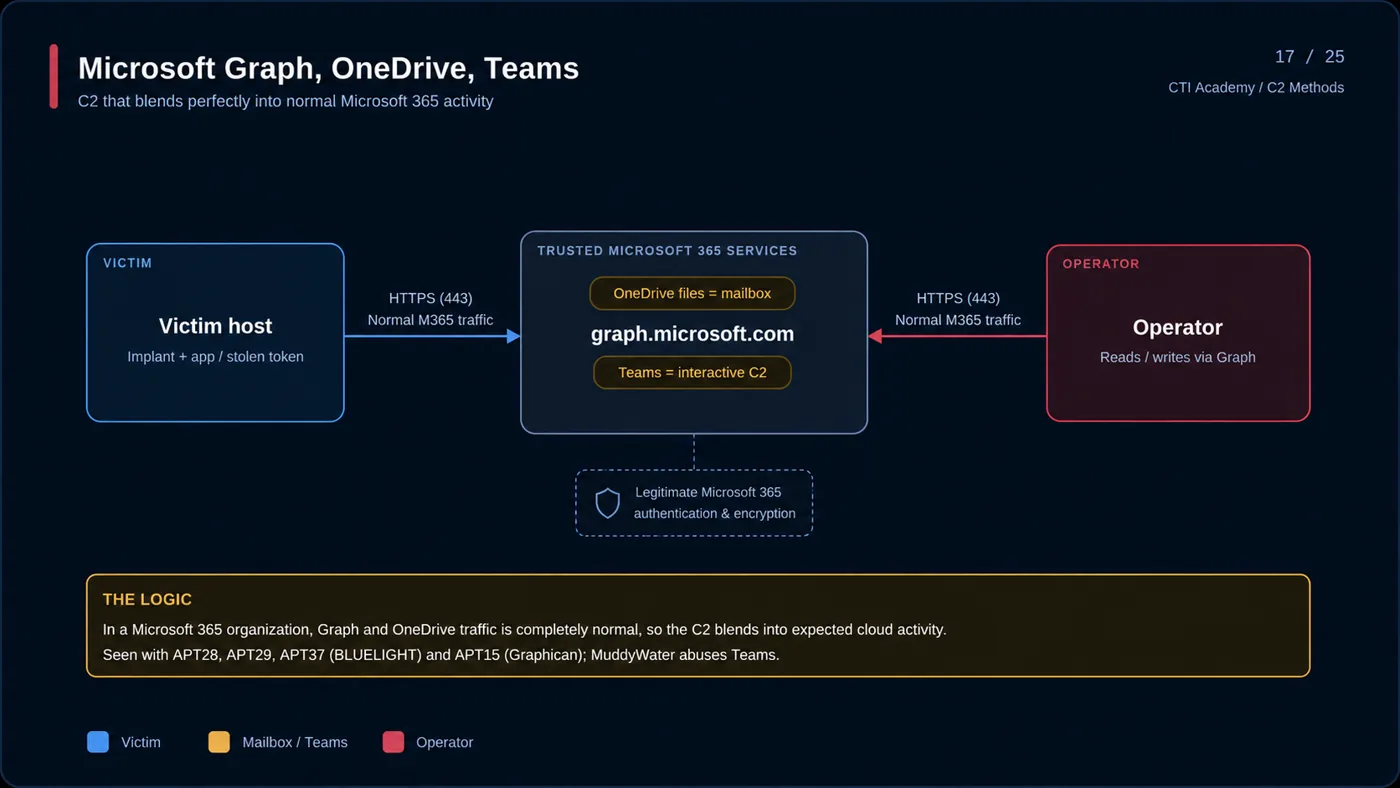
The implant uses the Microsoft Graph API with stolen or application tokens to read and write files in OneDrive or SharePoint, treating them as a mailbox. Microsoft Teams is abused for live social-engineering C2.
The logic: in a Microsoft 365 organization, Graph and OneDrive traffic is completely normal, so the C2 blends perfectly into expected cloud activity. This has been used by APT28, APT29, APT37 (BLUELIGHT), and APT15 (Graphican), while Iran's MuddyWater has abused Teams for interactive intrusions.
Pastebin and Dead Drop Resolvers
The malware fetches a public paste that contains the current C2 address, then connects to whatever it finds. The paste is the dead drop that resolves to the real C2.
The logic: this separates the "where is my C2" step from the C2 itself. Paste sites are cheap, anonymous, trusted, and trivial to update. APT41, FIN5, PlugX, and Turla's Carbon framework have all used paste sites this way.
Social Media and Cloud Storage C2
The C2 address can also be hidden in plain sight inside a Steam profile bio, a tweet, a YouTube video description, a forum post, or a cloud storage bucket. The malware reads the public page to learn where to connect.
The logic: these public pages are trusted and effectively impossible to block, which makes them resilient, anonymous dead drops. BLACKCOFFEE, used by APT17, hid its C2 in TechNet forum posts, and Lumma Stealer has stashed fallback C2 addresses in Steam profiles.
Key Takeaway
Trusted-service abuse defeats the two oldest detection methods at once. There is no malicious IP to block and no suspicious domain to flag, because the traffic genuinely goes to Telegram, Google, or Microsoft. Detection has to move from where traffic goes to how it behaves.
7. The Modern Frontier of C2
The newest C2 techniques push toward channels that are extremely difficult, and in some cases effectively impossible, to take down.
Blockchain C2 (EtherHiding)
The attacker stores the C2 configuration or payload inside a smart contract on a public blockchain. The malware reads it with a free, read-only call that creates no transaction and leaves almost no trace. To update the configuration, the attacker pays a tiny fee to change the contract data.
The logic: a blockchain is immutable and decentralized. There is no server to seize, no domain to block, and no provider to send a takedown notice to, which makes it bulletproof hosting by design. The technique appeared in the CLEARFAKE campaign and was later used by North Korea's UNC5342, the first observed nation-state use.
DNS over HTTPS (DoH) C2
DoH-based C2 sends DNS queries wrapped inside HTTPS to a public DoH resolver. The network sees only an HTTPS connection to a trusted resolver, never the DNS content inside.
The logic: this defeats DNS monitoring and filtering completely, turning a covert DNS channel that defenders could once watch into something invisible inside encrypted HTTPS. Godlua was the first malware observed abusing DoH, and PsiXBot hardcoded a public DoH endpoint.
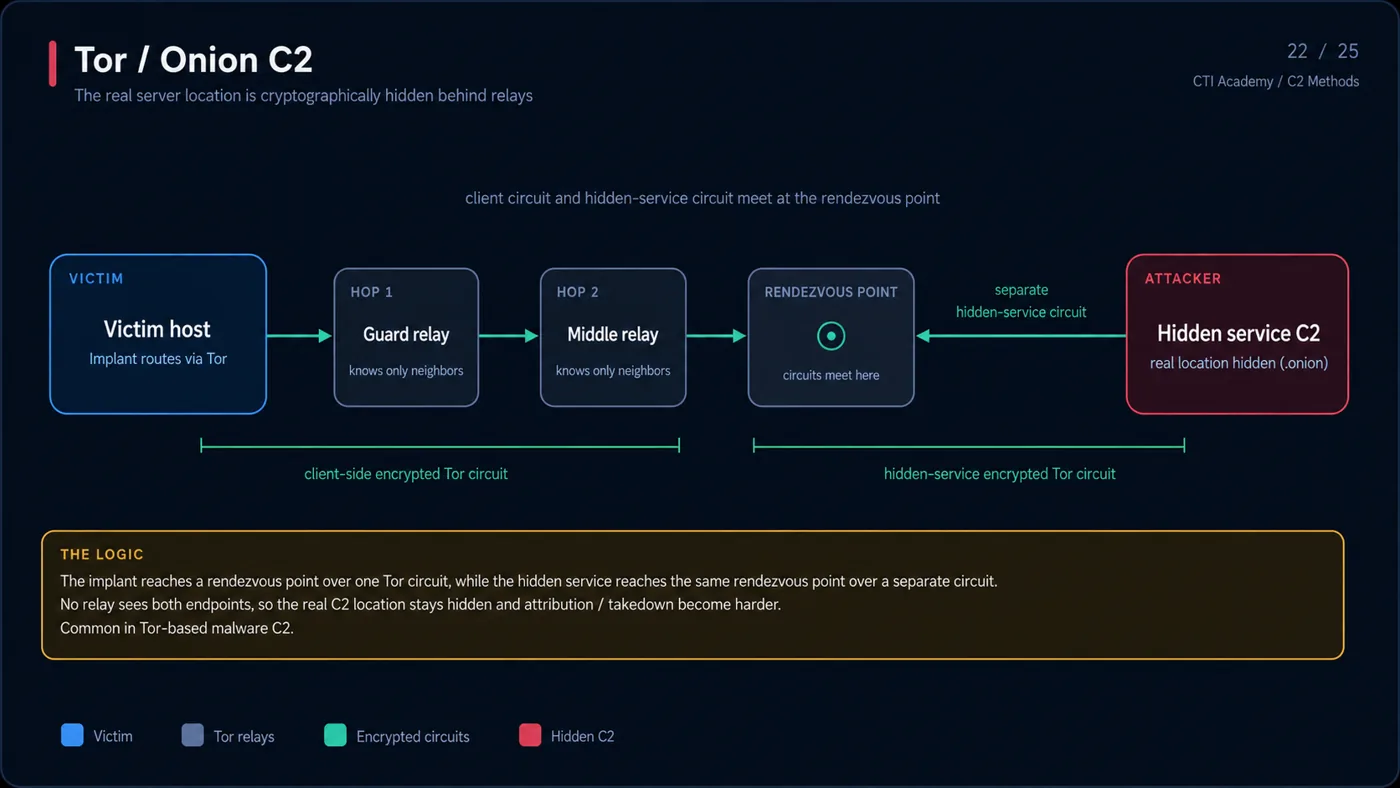
Tor and Onion C2
The C2 server is hosted as a .onion hidden service and the implant routes through the Tor network, so the true location of the server is cryptographically hidden.
The logic: Tor anonymizes the C2 and hides where the real server sits, making takedown and attribution far harder. SystemBC turned into a Tor backdoor inside Ryuk and Egregor ransomware, and nearly all modern ransomware uses Tor for negotiation and leak sites.
8. C2 Frameworks and Malleable Profiles
Most intrusions today do not use bespoke C2 code. Operators reach for a ready-made framework that bundles the implant, the server, the tasking interface, and built-in evasion into one package. These frameworks industrialize intrusion, turning capability that once required custom development into a point-and-click workflow.
The most common is Cobalt Strike, a legitimate commercial tool that is overwhelmingly deployed through cracked builds. A growing set of open-source and commercial alternatives, including Sliver, Havoc, Mythic, Brute Ratel, Empire, and Metasploit, has risen partly to dodge the mature detections that now exist for Cobalt Strike.
Malleable C2 Profiles
A malleable C2 profile, a concept pioneered by Cobalt Strike, is a configuration language that lets the operator reshape every network indicator: the User-Agent, the URLs, the headers, the data encoding, the sleep and jitter timing, even the TLS certificate. The same implant can be made to impersonate Amazon, Google, Slack, or another malware family entirely.
The logic: one tool, infinite disguises. Because the indicators are defined by the operator and change from one campaign to the next, static signatures simply fail. This is a major reason that behavior-based detection has become essential.
9. Detecting and Defending Against C2
Because modern C2 hides inside trusted traffic and reshapes its indicators at will, the most durable defenses focus on behavior rather than static blocklists. Correlating these findings with cyber threat intelligence and continuous attack surface management gives defenders an adversary-aware view of where C2 is most likely to appear.
Get Visibility
Baseline outbound traffic to high-abuse services such as Telegram, Microsoft Graph, Google APIs, Discord, GitHub, and Pastebin. Most organizations have legitimate traffic to some of these, so the goal is not to block them outright but to understand what normal looks like and to alert on machine-like, regular patterns that do not match human usage.
Engineer Detections
Several techniques target C2 directly:
- Beaconing analytics that flag regular check-in intervals once jitter is accounted for, often combined with JA3 and JA4 TLS fingerprints to identify implant traffic even when the destination looks benign.
- DNS and DoH monitoring to catch tunneling, including the volume and entropy of subdomain queries that indicate encoded data (see Unit 42's research on DNS tunneling).
- C2 framework signatures and memory scanning to catch Cobalt Strike, Sliver, and similar implants on the host.
- Blockchain query detection that flags read calls to smart contracts originating from applications that have no legitimate Web3 function.
Build Resilience
Adopt a default-deny egress posture so that only approved destinations are reachable, route DNS through controlled resolvers so that tunneling and DoH abuse are visible, and rotate or report tokens and accounts that have been abused for C2. Strong OSINT practices also help defenders find their own exposed infrastructure before attackers turn it into a C2 staging point.
Assume Takedowns Are Temporary
Every disruption buys time, not victory. Resilient designs such as P2P, DGA, and dead drop resolvers are built to recover, so after any takedown the priority is to hunt for the fallback channel before the operator re-establishes control.
Key Takeaway
You will not win against modern command and control with blocklists alone. The center of gravity has moved to trusted-service abuse and decentralized channels that defeat IP and domain blocking. Defenders win on behavior: focus on how traffic acts, not just where it goes.
10. Frequently Asked Questions
What does C2 mean in cybersecurity?
C2 stands for command and control. It is the communication channel and infrastructure a threat actor uses to remotely send commands to compromised systems and receive stolen data back. It is sometimes written as C2 or CnC.
What is the difference between a C2 server and a C2 channel?
The C2 server is the attacker-side endpoint that issues commands and collects results. The C2 channel is the transport that carries that traffic, such as HTTP, DNS, a messaging app, or a blockchain. One server can be reached through several different channels.
What is malware beaconing?
Beaconing is the periodic check-in an implant makes to its C2 server to ask for new commands. Because regular check-ins can reveal the malware, implants add random jitter and long sleep intervals to make the pattern harder to detect.
Why is command and control so hard to detect today?
Modern C2 increasingly hides inside trusted services like Telegram, Google, and Microsoft, where there is no malicious IP or suspicious domain to flag. Combined with encryption and operator-defined indicators through malleable profiles, this defeats traditional blocklist and signature detection, which is why behavior-based detection is now essential.
What is the most common C2 method?
HTTP and HTTPS beaconing remains the most common transport because web traffic is allowed out of nearly every network and TLS hides the content. It is the default channel for most commodity malware and for frameworks like Cobalt Strike.