
Open Source Intelligence (OSINT) is the practice of collecting, analyzing, and acting on information gathered from publicly available sources. In a world where digital footprints expand with every click, OSINT has become one of the most powerful disciplines in cyber threat intelligence, law enforcement, journalism, and corporate security. Whether you are investigating a phishing campaign, verifying a source, or mapping an organization's attack surface, OSINT provides the foundation for evidence-based decision-making without ever crossing ethical or legal boundaries.
This guide walks you through the core methodology, advanced techniques, and practical tools that professional OSINT analysts use every day. By the end, you will have a clear roadmap for conducting structured open source investigations from start to finish.
1. What Is OSINT?
OSINT refers to intelligence derived from publicly available information that is collected, exploited, and disseminated in a timely manner to an appropriate audience for the purpose of addressing a specific intelligence requirement. The term originated in military and government intelligence circles during the Cold War, when analysts realized that a significant portion of actionable intelligence could be gathered from newspapers, radio broadcasts, academic publications, and public records rather than covert operations alone.
Today, the scope of OSINT has expanded dramatically. Publicly available information now includes social media posts, website registrations, DNS records, satellite imagery, court filings, patent databases, code repositories, and billions of indexed web pages. The U.S. Intelligence Community estimates that up to 80 percent of the intelligence needed for most decision-making comes from open sources.
Within the intelligence cycle, OSINT plays a role at every stage. During planning and direction, analysts define what publicly available data might answer their questions. During collection, they gather that data systematically. During processing and analysis, they transform raw information into structured findings. And during dissemination, those findings reach stakeholders who act on them. This cycle repeats continuously, with each round refining the questions and the methods used to answer them.
OSINT vs. Other Intelligence Disciplines
OSINT is one of several intelligence disciplines. HUMINT (Human Intelligence) relies on interpersonal contact. SIGINT (Signals Intelligence) intercepts electronic communications. IMINT (Imagery Intelligence) analyzes satellite and aerial photography. What makes OSINT distinct is its accessibility: anyone with an internet connection and the right methodology can conduct it, without specialized hardware or classified access.
2. OSINT Methodology and Frameworks
Effective OSINT is never random browsing. It follows a structured process that ensures completeness, accuracy, and reproducibility. The most widely adopted framework follows four phases:
- Planning and Requirements Definition: Clearly define what you need to find out. What is the intelligence question? What decisions will the findings support? Scope the investigation to avoid rabbit holes and set boundaries for time, resources, and legal constraints.
- Collection: Systematically gather data from identified sources. This is where search engine queries, API calls, web scraping, and manual review happen. Document every source and timestamp every finding for later verification.
- Processing and Analysis: Raw data is rarely useful on its own. This phase involves deduplication, cross-referencing, timeline construction, link analysis, and pattern recognition. Transform scattered data points into coherent intelligence products.
- Reporting and Dissemination: Present findings in a format appropriate for the audience. A technical report for an incident response team looks very different from a briefing for a board of directors. Always include confidence levels and source reliability assessments.
Key Takeaway
Always start with a clear question. The difference between professional OSINT and aimless googling is structure. Define your requirements before you open a browser tab, and document every step so your findings can be verified and reproduced.
Several established frameworks can guide your process. The OSINT Framework organizes tools by category. The Intelligence Cycle adapted from military doctrine provides the overarching workflow. And ACH (Analysis of Competing Hypotheses) helps analysts avoid confirmation bias by forcing them to evaluate evidence against multiple explanations rather than seeking data that confirms a single theory.
3. Advanced Search Engine Techniques
Search engines index billions of pages, but most users only scratch the surface. Google dorking, also known as Google hacking, uses advanced search operators to extract precisely targeted information from search engine indexes. These operators act as filters that narrow results to exactly what you need.
Essential Google Dorking Operators
site:- Restricts results to a specific domain. Example:site:example.com "internal use only"finds pages on example.com containing that phrase.filetype:- Finds specific file types. Example:filetype:pdf site:gov.uk "cyber security strategy"locates PDF documents on UK government sites.intitle:- Searches within page titles. Example:intitle:"index of" "backup"can reveal exposed directory listings containing backup files.inurl:- Searches within URLs. Example:inurl:admin loginfinds pages with "admin" in the URL and "login" on the page.cache:- Shows Google's cached version of a page, useful when the original has been taken down.-(minus) - Excludes terms. Example:site:example.com -inurl:blogshows pages on example.com excluding blog posts.
Practical Dorking Examples
Combining operators creates powerful queries. To find exposed configuration files on a target domain:
site:example.com filetype:env OR filetype:cfg OR filetype:confTo discover login portals and admin panels:
site:example.com inurl:"/admin" OR inurl:"/login" OR inurl:"/portal"To find documents that may contain sensitive information:
site:example.com filetype:xlsx OR filetype:docx "confidential" OR "internal"Beyond Google, consider using Bing, Yandex, and DuckDuckGo. Each engine indexes differently, and Yandex in particular excels at reverse image searches and indexing content from certain geographic regions that Google may deprioritize.
4. Website Intelligence Gathering
Every website leaves a trail of technical metadata that reveals far more than its visible content. Systematic website intelligence gathering uncovers ownership, infrastructure, technology choices, and historical changes.
WHOIS and DNS Analysis
WHOIS lookups reveal domain registration details including registrant name, organization, email, registration date, and nameservers. While privacy services mask many records today, historical WHOIS data (available through services like DomainTools) often preserves the original registrant details from before privacy was enabled.
DNS enumeration maps the infrastructure behind a domain. Query A, AAAA, MX, TXT, CNAME, and NS records to identify mail servers, hosting providers, CDN usage, and domain verification entries. SPF and DMARC records in TXT entries reveal email security posture. Subdomain enumeration through certificate transparency logs, DNS brute-forcing, and passive DNS databases can expose development servers, staging environments, and forgotten assets that expand the attack surface.
Technology Stack Analysis
Tools like Wappalyzer and BuiltWith identify the CMS, frameworks, analytics platforms, advertising networks, and server software a website uses. This information reveals potential vulnerabilities associated with specific software versions and helps analysts understand the technical sophistication of the target organization.
Historical Analysis with the Wayback Machine
The Internet Archive's Wayback Machine stores snapshots of websites over time. Analysts use it to view pages that have been removed, track changes in site content, recover deleted documents, and identify former employees or partners listed on older versions of corporate pages. Historical snapshots can also reveal when security measures were implemented or removed.
Certificate Transparency Logs
Certificate Transparency (CT) logs are public records of every SSL/TLS certificate issued for a domain. Querying CT logs through services like crt.sh reveals all subdomains that have ever had certificates issued, including internal hostnames, development environments, and API endpoints that may not be publicly linked.
5. Code Repository Intelligence
Public code repositories on GitHub, GitLab, and Bitbucket are treasure troves for OSINT analysts. Developers frequently commit sensitive information inadvertently, and even when secrets are removed from the latest version, they persist in the commit history.
What to Look For
- Exposed credentials: Hardcoded passwords, API keys, and authentication tokens committed to public repositories.
- Environment files:
.envfiles containing database connection strings, secret keys, and third-party service credentials. - Configuration files:
config.yml,settings.py, and similar files that reveal internal infrastructure details, IP addresses, and service endpoints. - Internal documentation: README files, wikis, and comments that describe internal architecture, deployment processes, and security controls.
- Commit history: Even deleted secrets remain in git history. Use
git logand tools like GitLeaks or TruffleHog to scan the entire history of a repository.
GitHub's advanced search syntax allows targeted queries. For example, org:targetcompany filename:.env searches for environment files within a specific organization's repositories. Searching for "password" extension:json org:targetcompany can reveal configuration files with embedded credentials.
6. Social Media Intelligence (SOCMINT)
Social media platforms generate vast quantities of voluntarily shared personal and organizational data. SOCMINT is the discipline of collecting and analyzing this data for intelligence purposes.
Platform-Specific Techniques
- LinkedIn: Map organizational structures, identify employees by role, track career movements, and discover technology stacks through job postings. Employees often list internal tools, frameworks, and security products in their profiles.
- Twitter/X: Monitor real-time discussions, track hashtags, analyze follower networks, and identify sentiment around events. Geolocation data embedded in tweets, when available, adds spatial context.
- Facebook and Instagram: Profile analysis, group memberships, check-in locations, tagged photos, and friend network mapping. Even with privacy settings enabled, profile pictures, cover photos, and public interactions often remain visible.
- Telegram and Discord: Public channels and servers frequently host discussions about cybercrime, data leaks, and underground markets. These platforms are increasingly important for monitoring threat actor activity.
Metadata Analysis
Images shared on social media sometimes retain EXIF metadata containing GPS coordinates, camera model, timestamp, and software used to edit the image. While most major platforms strip EXIF data on upload, images shared through direct messages, forums, or less mainstream platforms may preserve this information. Analyzing metadata can verify the authenticity of images and establish when and where they were taken.
7. Geospatial Intelligence (GEOINT)
GEOINT applies geographic and spatial analysis to intelligence problems. In the OSINT context, this means using publicly available satellite imagery, street-level photographs, and mapping data to verify locations, track movements, and analyze physical infrastructure.
Satellite Imagery Analysis
Free platforms like Google Earth, Bing Maps, and Sentinel Hub provide satellite imagery at varying resolutions and time intervals. Analysts use these to verify claims about physical locations, monitor construction at sensitive sites, and track changes over time using historical imagery layers.
Shadow Analysis and Chronolocation
Shadows in images provide precise temporal information. By measuring shadow length and direction and comparing them against the sun's position for a given date and latitude, analysts can determine the approximate time a photograph was taken. This technique, known as chronolocation, is invaluable for verifying the claimed date and time of images and videos.
Location Verification
Cross-referencing visual elements in photos and videos against satellite and street-level imagery confirms or disproves claimed locations. Analysts look for distinctive architectural features, signage, vegetation, road markings, vehicle types, and terrain characteristics. Combining multiple indicators significantly increases confidence in geolocation findings. This technique has been used extensively in conflict verification and investigative journalism, popularized by organizations like Bellingcat, which publishes an open toolkit for this kind of work.
8. People Investigation
Investigating individuals through open sources requires building a comprehensive picture from fragmented data scattered across the internet. This process involves layering different types of information to create a reliable profile.
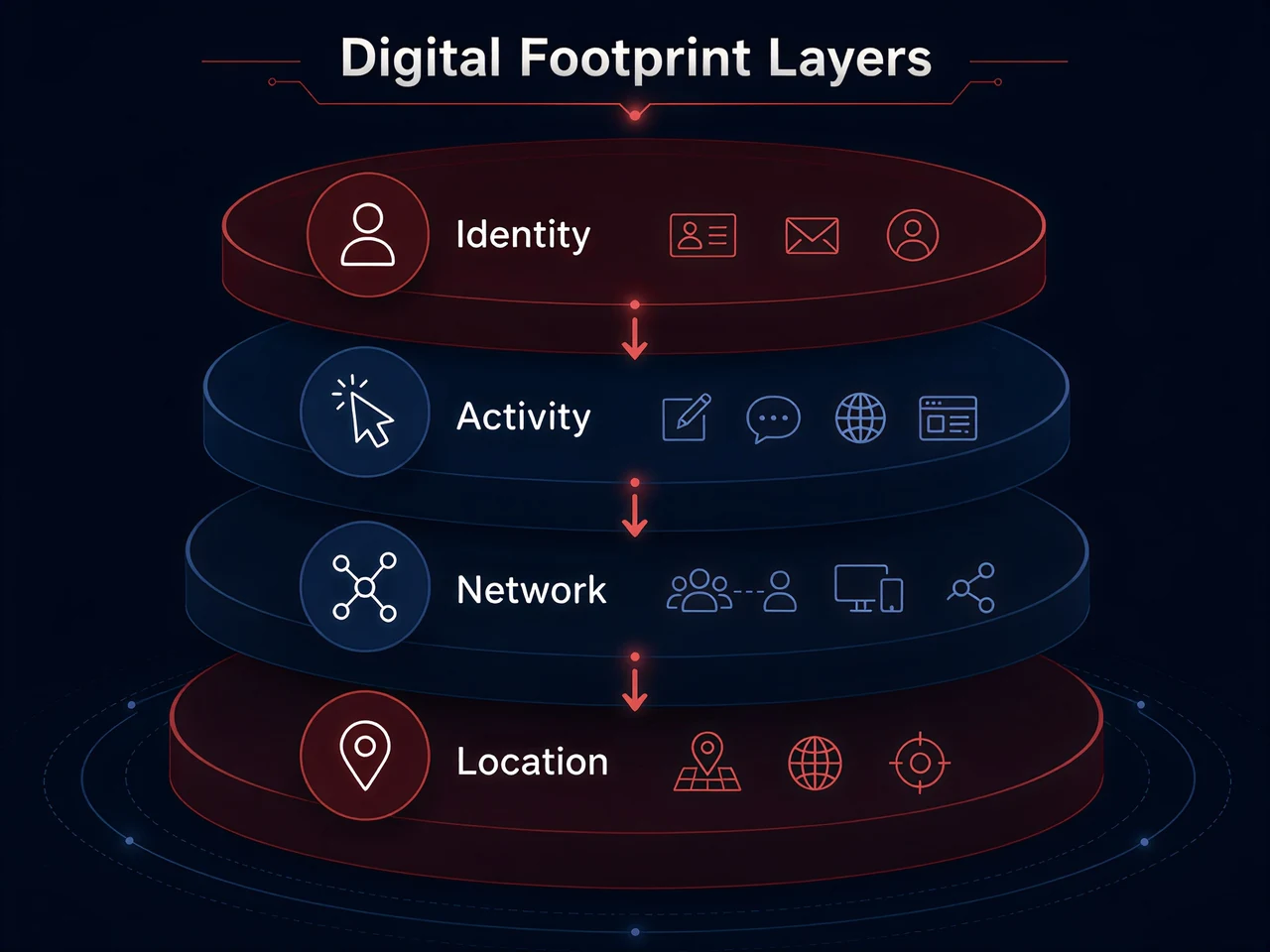
Digital Footprint Layers
- Identity layer: Names, email addresses, phone numbers, usernames, and profile photographs. Username enumeration tools check whether a specific handle exists across hundreds of platforms simultaneously.
- Activity layer: Social media posts, forum comments, blog articles, code contributions, and review site activity. This layer reveals interests, opinions, skills, and behavioral patterns.
- Network layer: Connections, followers, group memberships, co-authors, and professional associations. Network analysis reveals relationships, influence, and organizational affiliations.
- Location layer: Check-ins, geotagged posts, IP-linked data, and references to physical locations in text. Establishing patterns of life through location data provides powerful investigative leads.
Cross-Referencing and Identity Verification
A single data point is rarely conclusive. Effective people investigation cross-references findings across multiple independent sources. An email address found in a data breach might link to a social media profile, which links to a professional profile, which lists an employer, which connects to a domain registration. Each connection strengthens confidence in the overall finding. Always assess the reliability of each source independently and note where the chain of evidence is strong versus where it relies on assumptions.
9. OSINT Tools Overview
The OSINT ecosystem includes hundreds of tools. Rather than mastering all of them, focus on understanding categories and becoming proficient with one or two tools in each:
- Search and Discovery: Maltego (link analysis and data mining), SpiderFoot (automated reconnaissance), Recon-ng (modular reconnaissance framework).
- Domain and Infrastructure: Amass (subdomain enumeration), Shodan (internet-connected device search), Censys (internet-wide scanning data), theHarvester (email and subdomain gathering).
- Social Media: Sherlock (username enumeration across platforms), Twint (Twitter/X scraping without API), Social-Analyzer (profile detection).
- Geospatial: Google Earth Pro, SunCalc (shadow and sun position analysis), Sentinel Hub (satellite imagery).
- Metadata and Files: ExifTool (image metadata extraction), FOCA (document metadata analysis), Metagoofil (metadata extraction from public documents).
- Credential and Code: GitLeaks (secret scanning in git repos), TruffleHog (credential detection), Have I Been Pwned (breach data lookup).
10. Ethics and Legal Considerations
The power of OSINT comes with significant responsibility. Just because information is publicly available does not mean it is ethical or legal to collect, store, and use it in every context.
- Legal compliance: Data protection regulations like GDPR, CCPA, and national privacy laws govern how personal data can be collected and processed, even when that data is publicly available. Understand the legal framework in your jurisdiction before conducting investigations.
- Proportionality: Collect only what is necessary for your intelligence requirement. Mass data harvesting without a specific purpose is both unethical and often illegal.
- Operational security: Protect your own identity during investigations. Use dedicated research accounts, VPNs, and virtual machines to prevent your activity from alerting investigation subjects or compromising your personal security.
- Source protection: If your investigation involves sources who have shared information, ensure their identity is protected in your reporting.
- Verification before action: Never act on unverified OSINT. Cross-reference findings through multiple independent sources before including them in intelligence products. Misattribution can cause serious harm to innocent people.
Professional OSINT analysts follow a personal code of ethics that prioritizes accuracy, privacy, legality, and minimal harm. Organizations conducting OSINT should establish clear policies, provide training on legal boundaries, and implement oversight mechanisms to prevent abuse.
Conclusion
Open Source Intelligence is a discipline that rewards structured thinking, methodical execution, and continuous learning. The techniques covered in this guide, from Google dorking and DNS analysis to SOCMINT and GEOINT, represent the core competencies that every OSINT analyst needs. But reading about these methods is only the first step. Real proficiency comes from practice: running your own investigations, refining your workflow, and developing the pattern recognition that separates experienced analysts from beginners.
If you want that practice in a structured order, the OSINT Learning Path is a hands-on OSINT course that starts from zero: collection planning, research OPSEC, verification, DNS and certificate pivots, public records and evidence handling, worked through case-based investigations. Once the basics hold, Advanced OSINT Investigations takes one domain or one address and turns it into a verified picture of the infrastructure behind it.
The field evolves rapidly. New platforms emerge, old ones change their APIs, and the volume of available data grows daily. Staying current requires active engagement with the OSINT community, regular practice, and a commitment to ethical conduct that maintains the trust and legitimacy of the discipline.
Frequently Asked Questions
What is OSINT in simple terms?
OSINT (Open Source Intelligence) is the practice of collecting and analyzing information from publicly available sources, such as websites, social media, and public records, to answer a specific intelligence question. It requires no classified access or specialized hardware.
What are the four phases of the OSINT process?
Planning and requirements definition, collection, processing and analysis, and reporting and dissemination. Each phase turns a raw intelligence question into a structured, verifiable finding.
Is OSINT legal?
Collecting publicly available information is generally legal, but how you use and store it is governed by data protection laws like GDPR and CCPA. Proportionality, source protection, and verification before action are core ethical requirements.
What tools do OSINT analysts use?
Common categories include search and discovery tools (Maltego, SpiderFoot), domain and infrastructure tools (Amass, Shodan, Censys), social media tools (Sherlock, Social-Analyzer), and metadata tools (ExifTool, FOCA). Methodology matters more than any single tool.
What is Google dorking?
Google dorking, also called Google hacking, uses advanced search operators like site:, filetype:, and intitle: to surface specific information indexed by search engines, including exposed files, login portals, and misconfigured directories.
What is the difference between OSINT and SOCMINT?
SOCMINT (Social Media Intelligence) is a subset of OSINT focused specifically on data gathered from social media platforms. OSINT is the broader discipline that also covers websites, public records, code repositories, and satellite imagery.
Key Takeaway
Tools are only as effective as the methodology behind them. A structured approach with a basic set of tools will consistently outperform an unstructured approach with expensive software. Invest in methodology first, tools second.