
1. What Is HUMINT?
HUMINT, or Human Intelligence, is the collection of information through interpersonal contact and human sources. Unlike signals intercepts or satellite imagery, HUMINT relies on direct engagement between intelligence officers and individuals who possess valuable knowledge. It is the oldest form of intelligence gathering, stretching back thousands of years to the earliest recorded civilizations.
In traditional espionage, HUMINT involved recruiting agents within foreign governments, military establishments, or organizations of interest. Intelligence agencies such as the CIA, MI6, and Mossad built their reputations on the ability to cultivate human sources in hostile environments. These operations demanded extraordinary patience, psychological insight, and meticulous operational discipline.
The evolution of HUMINT into the cyber domain represents one of the most significant shifts in intelligence history. As threat actors operate from behind keyboards spread across the globe, the need to understand their motivations, capabilities, and intentions has never been greater. Cyber threat intelligence analysts now apply HUMINT methodologies to infiltrate dark web communities, develop rapport with insiders, and gather information that no technical sensor can capture. The human element remains irreplaceable: source code can be analyzed by machines, but the reasons behind an attack, the identity of the adversary, and the next move in a campaign often require a human touch.
2. HUMINT vs Other Intelligence Disciplines
The intelligence community categorizes collection methods into several distinct disciplines. Understanding how HUMINT compares to these other approaches is essential for building a comprehensive cyber threat intelligence program.
| Discipline | Source | Main Limitation |
|---|---|---|
| SIGINT (Signals Intelligence) | Intercepted electronic communications, from radio to encrypted internet traffic | Reveals what is said, not why; faces growing encryption challenges |
| OSINT (Open Source Intelligence) | Publicly available data: social media, news, public records, academic publications | Cannot penetrate closed groups or classified environments |
| IMINT (Imagery Intelligence) | Satellite and aerial imagery | Limited direct application in cybersecurity contexts |
| HUMINT (Human Intelligence) | Direct interpersonal contact with human sources | Slow to develop, carries operational and ethical risk |
HUMINT fills the gaps that technical collection methods leave open. Where SIGINT captures the message, HUMINT reveals the messenger's intentions. Where OSINT maps the visible surface, HUMINT dives below it. The most effective intelligence programs integrate all disciplines, using HUMINT to validate, contextualize, and expand on technical findings.
3. Why HUMINT Matters in Cybersecurity
Technical intelligence tools, including intrusion detection systems, malware sandboxes, and network traffic analyzers, are indispensable. However, they have inherent blind spots. Firewalls cannot detect a disgruntled employee planning to exfiltrate data. Threat feeds cannot reveal the strategic objectives behind a state-sponsored campaign. Automated tools struggle to predict when a threat actor will pivot from reconnaissance to active exploitation.
HUMINT addresses these critical gaps by providing insight into motives, intent, and human decision-making. Consider the following scenarios where HUMINT proves essential:
- Insider threats: A trusted employee with legitimate access can bypass every technical control (see CISA's insider threat mitigation guidance). HUMINT enables organizations to understand behavioral indicators and develop early-warning mechanisms through trusted internal networks.
- Attribution: Determining who is behind a cyberattack often requires human sources within threat actor groups, intelligence sharing with partner agencies, or rapport-based engagement with informants in underground communities.
- Threat forecasting: Understanding an adversary's strategic goals, resource constraints, and internal politics allows analysts to anticipate future operations rather than merely react to past incidents.
- Supply chain risks: Evaluating the trustworthiness of vendors, contractors, and partners involves human judgment and relationship-based intelligence that cannot be automated.
Key Takeaway
Technical intelligence tells you what happened. HUMINT tells you why it happened and what is likely to happen next. The combination of both creates actionable intelligence that drives strategic decision-making.
The Human Source Collection for CTI (HUMINT) Learning Path turns this into practice: separating a claim from an observation, grading the source and the claim as two different judgments, and running a research persona inside a community without it leading back to you.
4. Human Psychology and Motivation
At the core of every HUMINT operation is an understanding of what drives people to share sensitive information. The intelligence community has long relied on the MICE model to categorize the primary motivations behind espionage and cooperation:
- Money: Financial incentives remain one of the most powerful motivators. Individuals facing debt, lifestyle aspirations beyond their income, or simple greed can be approached with financial offers in exchange for access or information.
- Ideology: Belief in a cause, whether political, religious, or ethical, drives some individuals to volunteer information. Whistleblowers, political dissidents, and ideologically motivated insiders often act without any material reward.
- Compromise (Coercion): Blackmail, threats, and exploitation of vulnerabilities such as past criminal activity, personal secrets, or compromising relationships can compel cooperation. This approach carries significant ethical and legal risks.
- Ego: The desire for recognition, importance, or validation motivates more people than most analysts initially expect. Individuals who feel undervalued in their organizations may share sensitive information simply to demonstrate their significance.
Beyond motivation, effective HUMINT practitioners master the art of rapport building. Establishing genuine trust requires active listening, empathy, patience, and the ability to identify shared interests or common ground. Rapport is not manipulation; it is the creation of a relationship where the source feels comfortable sharing information willingly.
Elicitation techniques complement rapport by guiding conversations toward intelligence requirements without revealing the true purpose of the discussion. Skilled practitioners use open-ended questions, deliberate misstatements to provoke corrections, flattery, and the appearance of shared knowledge to draw out critical details. In cybersecurity contexts, these same techniques prove invaluable during threat actor engagement, social engineering assessments, and insider threat investigations.
5. The Source Development Cycle
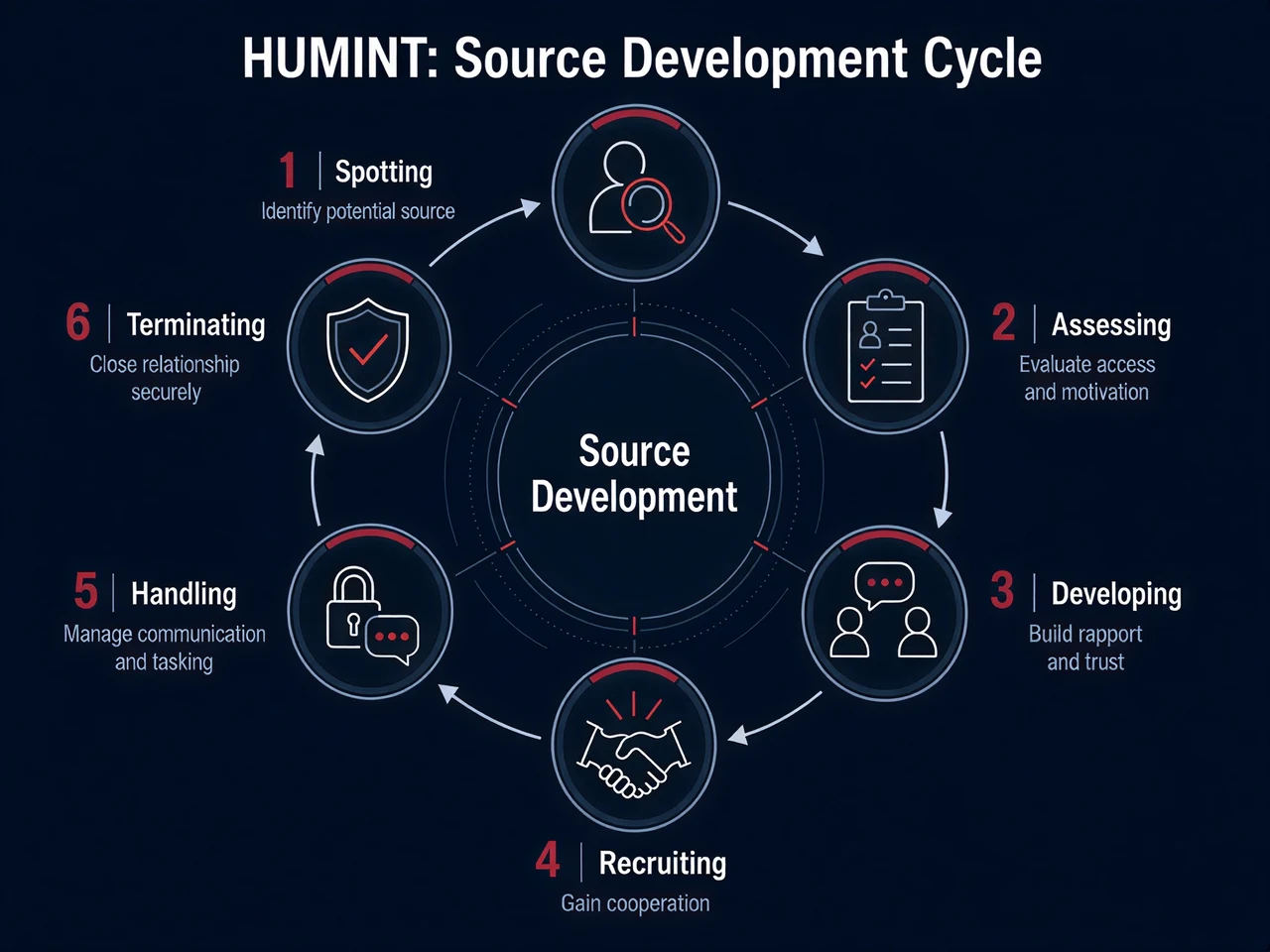
Professional intelligence organizations follow a structured process for developing human sources. This cycle ensures consistency, minimizes risk, and maximizes the value of each intelligence relationship.
Spotting
The cycle begins with identifying potential sources who have access to desired information. In cybersecurity, spotting might involve identifying individuals within threat actor forums, locating employees at target organizations with access to critical systems, or recognizing disgruntled insiders through behavioral analysis and OSINT research.
Assessing
Once a potential source is spotted, the assessment phase evaluates their access level, reliability, motivations, vulnerabilities, and potential counterintelligence risks. This phase determines whether pursuing the source is worth the investment and risk involved.
Developing
Development involves building a relationship with the potential source before any intelligence request is made. This stage focuses on establishing trust, understanding the source's personality, and creating the conditions for future cooperation. In digital environments, development might occur through sustained engagement in forums, private messaging, or collaborative projects.
Recruiting
The recruitment pitch is the moment when the intelligence officer formally requests cooperation. This step requires careful timing, a deep understanding of the source's motivations, and a clear value proposition. Premature recruitment attempts can destroy months of development work.
Handling
After recruitment, ongoing management of the source relationship is critical. Handling involves maintaining security protocols, managing the source's expectations, validating the intelligence provided, and ensuring the source remains motivated and productive over time.
Terminating
All source relationships eventually end. Termination must be handled carefully to protect both the source and the intelligence organization. Proper termination procedures prevent security breaches, minimize the risk of retaliation, and preserve the possibility of future reactivation if circumstances change.
6. Operational Security and Tradecraft
Operational security (OPSEC) is the backbone of every HUMINT operation. A single lapse in tradecraft can compromise an entire network of sources, endanger lives, and destroy years of intelligence work. The principles of OPSEC apply equally to traditional espionage and modern cyber intelligence operations.
Cover identities protect the intelligence officer's true affiliation and purpose. In the digital realm, this translates to the use of carefully crafted online personas, each with a consistent backstory, posting history, and behavioral pattern. Maintaining cover requires discipline: every action taken under a cover identity must align with the persona's established characteristics.
Secure communications ensure that exchanges between handlers and sources cannot be intercepted or traced. Traditional methods included dead drops, one-time pads, and coded language. Modern cyber HUMINT operations leverage end-to-end encrypted messaging platforms, anonymization networks like Tor, steganography, and ephemeral communication channels that leave minimal forensic traces.
Surveillance detection involves recognizing when an operation is being monitored by hostile actors. In physical operations, this means detecting physical surveillance teams. In cyber operations, it means identifying honeypots, monitoring for signs that forum administrators are tracking private conversations, and recognizing behavioral analysis tools designed to unmask undercover personas.
Compartmentalization limits the damage caused by any single compromise. By ensuring that no individual has knowledge of the entire operation, organizations contain the blast radius of a security breach. Each source knows only what is necessary for their role, and intelligence products are distributed on a strict need-to-know basis.
7. Counterintelligence and HUMINT
Counterintelligence (CI) is the other side of the HUMINT coin. While HUMINT seeks to collect information from adversaries, counterintelligence works to prevent adversaries from doing the same to you. The two disciplines are deeply intertwined, and effective CI programs rely heavily on HUMINT capabilities.
Double agents represent both the greatest opportunity and the greatest risk in HUMINT operations. A double agent is a source who appears to be working for one side while actually serving the other. Managing double agents requires exceptional tradecraft, as the intelligence officer must continuously assess the source's true loyalties while feeding controlled information to the adversary.
Denial and deception (D&D) operations aim to prevent adversaries from collecting accurate intelligence while feeding them misleading information. In cybersecurity, D&D techniques include deploying honeypots and honeynets, planting false indicators of compromise, and creating deceptive network architectures designed to waste attacker resources and reveal their methodologies.
Penetration detection involves identifying whether an adversary has successfully placed a source within your organization. Behavioral analysis, anomaly detection in access patterns, lifestyle monitoring, and periodic security reviews all contribute to penetration detection efforts. In the cyber domain, this extends to identifying compromised accounts, detecting unauthorized data access, and monitoring for signs that internal communications have been intercepted.
8. Ethics, Law, and Case Studies
HUMINT operations, whether in traditional espionage or cybersecurity, raise profound ethical and legal questions. Organizations must navigate complex frameworks governing privacy, consent, deception, and the use of coercive techniques.
Legal frameworks vary significantly across jurisdictions. In the United States, intelligence activities are governed by Executive Order 12333, the Foreign Intelligence Surveillance Act (FISA), and agency-specific regulations. European operations must contend with GDPR and the European Convention on Human Rights. Private sector organizations conducting HUMINT-like activities face additional restrictions under corporate law, employment regulations, and contractual obligations.
Ethical dilemmas arise at every stage of the source development cycle. Is it ethical to exploit a source's financial desperation? Where is the line between rapport building and manipulation? How should an organization handle a source who faces personal danger as a result of their cooperation? These questions have no easy answers, but they demand careful consideration and institutional oversight.
Notable historical operations provide valuable lessons. The Cambridge Five infiltration of British intelligence by Soviet agents demonstrated the devastating impact of long-term penetration operations. Operation MINCEMEAT during World War II illustrated the power of denial and deception through human channels. More recently, intelligence operations targeting terrorist networks have shown how HUMINT can complement technical surveillance to prevent attacks. Each of these cases offers enduring principles that apply directly to modern cyber threat intelligence.
Frequently Asked Questions
What is HUMINT in cybersecurity?
HUMINT (Human Intelligence) is intelligence gathered through interpersonal contact rather than technical means. In cybersecurity, it means developing sources within threat actor communities, understanding attacker motivations, and using human-source methods to complement technical intelligence like SIGINT and OSINT.
What is the MICE model?
MICE stands for Money, Ideology, Compromise, and Ego, the four primary motivations the intelligence community uses to explain why a person might share sensitive information or cooperate as a source.
How is HUMINT different from OSINT?
OSINT draws only from publicly available information and cannot penetrate closed groups or classified environments. HUMINT relies on direct interpersonal relationships and can reach information that is never made public, but requires far more time, risk management, and ethical oversight.
What is the source development cycle?
A six-stage process: spotting a potential source, assessing their access and reliability, developing a relationship, recruiting their cooperation, handling the ongoing relationship, and eventually terminating it in a way that protects both parties.
Is HUMINT ethical?
HUMINT raises genuine ethical questions around consent, deception, and coercion. Legitimate programs operate under clear legal authority (such as FISA in the United States or GDPR in Europe), institutional oversight, and a principle of proportionality.
Key Takeaway
Ethical HUMINT operations require clear legal authority, institutional oversight, and a commitment to proportionality. The ends do not automatically justify the means, and organizations must establish rigorous review processes to ensure compliance.
9. HUMINT in the Digital Age
The internet has fundamentally transformed how HUMINT is practiced. While the core principles remain unchanged, the operational environment has shifted dramatically from physical meetings in foreign capitals to encrypted conversations in dark web forums.
Dark web forums serve as the modern equivalent of back-alley meetings. Threat actors buy, sell, and trade tools, credentials, and services on marketplaces and forums accessible only through anonymization networks. HUMINT operators who can gain access to these communities, build credibility, and develop relationships with key actors provide intelligence that no automated scraping tool can replicate. Understanding forum culture, slang, trust systems, and reputation mechanisms is essential for effective engagement.
Social engineering represents the offensive application of HUMINT principles. Phishing campaigns, pretexting calls, and impersonation attacks all exploit the same psychological vulnerabilities that intelligence agencies have leveraged for decades. Understanding HUMINT tradecraft enables cybersecurity professionals to both execute realistic social engineering assessments and defend against adversaries who employ these techniques.
Online persona development has become a specialized discipline within cyber HUMINT. Creating and maintaining believable online identities requires consistent activity histories, realistic social connections, appropriate technical footprints, and behavioral patterns that withstand scrutiny. Advanced adversaries use linguistic analysis, metadata examination, and behavioral profiling to identify undercover operatives, making persona maintenance an increasingly sophisticated challenge.
The convergence of traditional HUMINT methodology with modern technology creates powerful capabilities for cyber threat intelligence teams. Analysts who understand both the human and technical dimensions of intelligence collection are uniquely positioned to uncover threats that purely technical approaches would miss.