
Information security is the practice of protecting data, systems, and networks from unauthorized access, disclosure, alteration, and destruction. Every organization, from global enterprises to small startups, depends on digital infrastructure. With that dependence comes risk. Cyberattacks are growing in frequency, sophistication, and impact, making information security one of the most critical disciplines of the modern era. Whether you are a student exploring career options, an IT professional looking to pivot, or a business leader trying to understand the threat landscape, this guide will give you a solid foundation in the principles, practices, and career opportunities that define the field of cybersecurity.
1. Why Information Security Matters Now
The numbers tell a stark story. According to IBM's Cost of a Data Breach Report, the global average cost of a data breach has stayed in the $4.4 to $4.9 million range in recent years. Ransomware attacks surged by over 70% year-over-year, and critical infrastructure sectors such as healthcare, energy, and finance faced an unprecedented wave of targeted intrusions. These are not abstract statistics; they translate into stolen patient records, disrupted power grids, and emptied bank accounts.
Digital transformation has amplified the attack surface dramatically. Cloud migration, remote work, IoT deployments, and the proliferation of APIs have created interconnected ecosystems where a single vulnerability can cascade across an entire supply chain. The 2024 MOVEit breach demonstrated exactly this scenario, compromising data from hundreds of organizations through a single file-transfer application.
Information security is no longer an IT concern alone. It is a business imperative, a legal requirement, and increasingly a matter of national security. Regulatory bodies worldwide are tightening compliance mandates, boards are demanding cybersecurity metrics, and consumers are choosing brands based on data-protection track records. Understanding infosec fundamentals is therefore essential for anyone participating in the digital economy.
2. Core Principles: The CIA Triad
At the heart of information security lie three foundational principles known as the CIA triad: Confidentiality, Integrity, and Availability. Every security control, policy, and architecture decision maps back to one or more of these pillars.
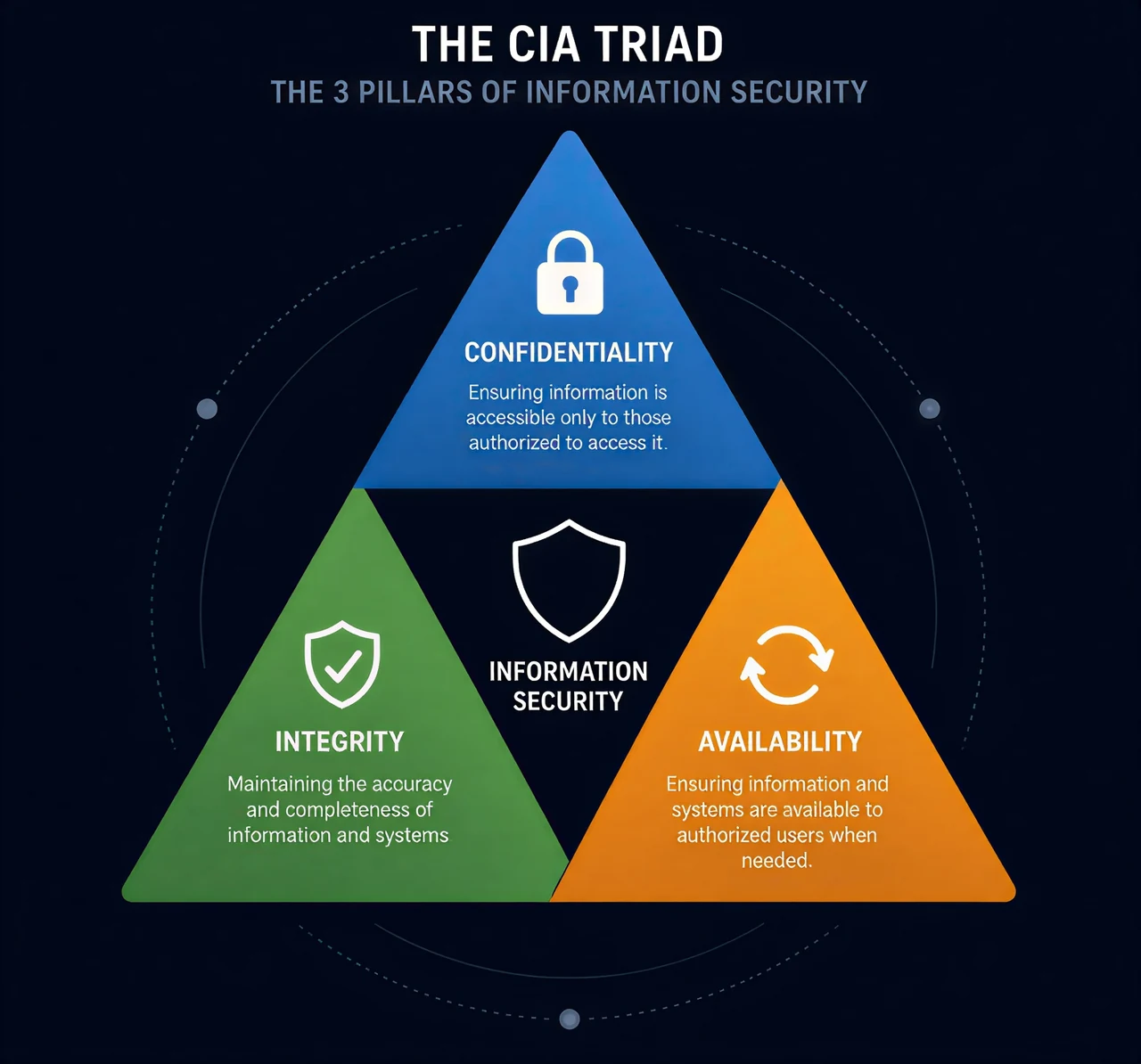
Confidentiality
Confidentiality ensures that sensitive information is accessible only to authorized individuals. When a hospital encrypts patient records so that only treating physicians can read them, it is enforcing confidentiality. Breaches of confidentiality, such as the exposure of 530 million Facebook user records in 2021, erode public trust and trigger regulatory penalties. Key controls include encryption, access control lists, multi-factor authentication, and data classification schemes.
Integrity
Integrity guarantees that data remains accurate, complete, and unaltered by unauthorized parties. Consider a financial institution where an attacker modifies transaction amounts in transit. Even without stealing data, the corruption of integrity can cause catastrophic financial losses. Hashing algorithms (SHA-256, for example), digital signatures, version control, and checksums are common mechanisms for verifying integrity. In practice, integrity also extends to system configurations: if an attacker modifies firewall rules without detection, the entire security posture is compromised.
Availability
Availability means that systems and data are accessible to authorized users when needed. A distributed denial-of-service (DDoS) attack that takes an e-commerce site offline during Black Friday directly attacks availability, costing millions in lost revenue. Redundancy, load balancing, disaster recovery planning, and regular backups are the primary defenses. The 2023 attacks against major cloud providers reminded the industry that even the largest platforms are not immune to availability disruptions.
Key Takeaway
The CIA triad is not just a theoretical framework. Every security decision you make, from choosing a password policy to designing a network architecture, should be evaluated against these three pillars. A strong security posture requires balance across all three.
3. Understanding the Adversary
Effective defense requires understanding who is attacking, why, and how. Threat actors fall into several broad categories, each with distinct motivations and capabilities.
- Nation-State Actors: Government-sponsored groups with significant resources and long-term strategic objectives. Groups like APT28 (Russia), APT41 (China), and Lazarus Group (North Korea) conduct espionage, intellectual property theft, and destructive attacks. Their operations are patient, well-funded, and often target critical infrastructure or defense contractors.
- Organized Cybercrime: Financially motivated groups that operate like businesses, complete with customer support for ransomware victims. The RaaS (Ransomware-as-a-Service) model has democratized cybercrime, allowing technically unsophisticated actors to launch devastating attacks. Groups like LockBit and BlackCat generate hundreds of millions in ransom payments annually.
- Insider Threats: Current or former employees, contractors, or partners who misuse legitimate access. Insider threats are particularly dangerous because they bypass perimeter defenses entirely. Motivations range from financial gain to disgruntlement to simple negligence. Studies consistently show that insider incidents account for roughly 25-30% of all breaches.
- Hacktivists: Ideologically motivated actors who use cyberattacks to advance political or social causes. Groups like Anonymous and their successors deface websites, leak data, and launch DDoS attacks against targets they consider unethical. While their technical sophistication varies, their operations can cause significant reputational damage and service disruption.
Understanding these actor categories helps security teams prioritize threats and allocate resources effectively. A defense contractor faces a different threat profile than a retail chain, and their security strategies should reflect that reality. This is where disciplines like Cyber Threat Intelligence (CTI) become invaluable, providing context that transforms raw data into actionable insight.
4. Common Attack Vectors
Threat actors exploit a variety of pathways to compromise systems. Understanding these vectors is the first step toward defending against them.
Phishing and Social Engineering
Phishing remains the most common initial access vector, responsible for over 36% of breaches. Attackers craft convincing emails, messages, or phone calls to trick users into revealing credentials, clicking malicious links, or downloading malware. Spear phishing targets specific individuals with personalized content, while business email compromise (BEC) impersonates executives to authorize fraudulent wire transfers. Social engineering exploits human psychology rather than technical vulnerabilities, making it notoriously difficult to defend against with technology alone.
Malware and Ransomware
Malware encompasses a broad category of malicious software, including viruses, trojans, worms, spyware, and rootkits. Ransomware has become the most financially impactful form, encrypting victim data and demanding payment for decryption keys. Modern ransomware operators employ "double extortion," exfiltrating data before encryption and threatening public release. Some have escalated to "triple extortion," directly pressuring the victim's customers or partners.
Supply Chain Attacks
Rather than attacking a target directly, adversaries compromise a trusted supplier or software vendor. The SolarWinds attack of 2020 remains the defining example: by injecting malicious code into a routine software update, attackers gained access to 18,000 organizations, including multiple US government agencies. Supply chain attacks are difficult to detect because the malicious component arrives through a trusted channel.
Zero-Day Exploits
Zero-day vulnerabilities are flaws unknown to the software vendor, meaning no patch exists when exploitation begins. These are prized by nation-state actors and sold on black markets for hundreds of thousands to millions of dollars. The Log4Shell vulnerability (CVE-2021-44228) demonstrated how a single zero-day in a widely used library could expose millions of systems simultaneously.
5. Building the Shield: Defense Strategies
Defense in depth, the practice of layering multiple security controls, is the guiding philosophy of modern cybersecurity. No single technology or process can stop every attack, but a well-designed combination of controls makes successful compromise exponentially more difficult.
Encryption Fundamentals
Encryption transforms readable data (plaintext) into an unreadable format (ciphertext) using mathematical algorithms. Symmetric encryption (AES-256) uses the same key for encryption and decryption and is fast enough for bulk data. Asymmetric encryption (RSA, ECC) uses a key pair, public and private, enabling secure key exchange and digital signatures. Modern best practice requires encryption for data at rest (stored on disk), data in transit (moving across networks via TLS/SSL), and increasingly data in use (through techniques like homomorphic encryption).
Network Security
Firewalls act as gatekeepers, filtering traffic based on predefined rules. Next-generation firewalls (NGFWs) add deep packet inspection, application awareness, and threat intelligence integration. Intrusion Detection Systems (IDS) monitor network traffic for suspicious patterns, while Intrusion Prevention Systems (IPS) take automated action to block detected threats. Network segmentation isolates critical assets, limiting the blast radius of a breach. Virtual private networks (VPNs) and software-defined perimeters secure remote access.
Access Control and Identity Management
The principle of least privilege dictates that users receive only the minimum access necessary for their role. Role-based access control (RBAC), multi-factor authentication (MFA), and privileged access management (PAM) are essential controls. Identity and access management (IAM) platforms centralize these capabilities, providing single sign-on, lifecycle management, and audit trails.
Zero-Trust Architecture
The traditional perimeter-based security model assumed that everything inside the network was trusted. Zero trust eliminates that assumption. Every access request is verified regardless of source location, following the principle of "never trust, always verify." Key components include micro-segmentation, continuous authentication, device health checks, and real-time policy enforcement. Organizations adopting zero trust report significantly lower breach costs and faster detection times.
For those interested in the Linux platform, understanding how these defense layers apply to open-source environments adds practical depth to your security knowledge.
6. Incident Response Basics
No defense is perfect. When a breach occurs, a well-rehearsed incident response (IR) plan determines whether the organization contains the damage in hours or suffers weeks of disruption. The standard IR lifecycle follows five phases.
- Detection and Identification: Security monitoring tools (SIEM, EDR, NDR) generate alerts. Analysts triage these alerts to distinguish genuine incidents from false positives. Speed matters: the average time to identify a breach is still 194 days, and reducing this window directly limits damage.
- Containment: Once confirmed, the immediate priority is preventing the attacker from expanding their foothold. Short-term containment might involve isolating affected systems from the network. Long-term containment applies temporary fixes while preserving forensic evidence for investigation.
- Eradication: The root cause is identified and removed. This might involve patching a vulnerability, removing malware, resetting compromised credentials, or rebuilding affected systems from clean backups. Incomplete eradication risks re-compromise.
- Recovery: Systems are restored to normal operation. This phase includes verifying that eradication was successful, monitoring for signs of continued adversary activity, and gradually returning services online. Recovery plans should be tested regularly through tabletop exercises and simulations.
- Lessons Learned: A post-incident review documents what happened, what worked, what failed, and what must change. This phase is often neglected under operational pressure, but it is arguably the most valuable. Each incident is an opportunity to strengthen defenses and update response procedures.
Key Takeaway
Incident response is not just a technical exercise. It requires coordination across IT, legal, communications, and executive leadership. Organizations that rehearse their IR plans through regular drills respond faster and more effectively when real incidents occur.
7. Governance, Risk & Compliance
Technical controls alone are insufficient without a governance framework that aligns security with business objectives. Governance, Risk, and Compliance (GRC) provides the structure for managing information security at an organizational level.
ISO 27001 is the international standard for information security management systems (ISMS). It provides a systematic approach to managing sensitive data through risk assessment, control implementation, and continuous improvement. Certification demonstrates to customers, partners, and regulators that an organization takes security seriously.
The NIST Cybersecurity Framework (CSF) organizes security activities into five core functions: Identify, Protect, Detect, Respond, and Recover. Its flexibility makes it applicable to organizations of any size or sector, and it has become the de facto standard in the United States. The 2024 update (NIST CSF 2.0) added "Govern" as a sixth function, reflecting the growing importance of cybersecurity governance at the executive level.
Other important frameworks include SOC 2 for service organizations, PCI DSS for payment card data, HIPAA for healthcare information, and GDPR for European data protection. Understanding which frameworks apply to your organization and how to implement their requirements is a core competency for information security professionals.
Risk management ties everything together. By identifying assets, assessing threats and vulnerabilities, and quantifying potential impact, organizations can make informed decisions about where to invest limited security resources. This risk-based approach ensures that the most critical assets receive the strongest protections.
8. Career Paths in Cybersecurity
The cybersecurity talent shortage continues to grow, with an estimated 3.5 million unfilled positions worldwide. CISA publishes free training and career resources for newcomers to the field. This gap represents an enormous opportunity for individuals willing to invest in developing the right skills. Here are some of the most sought-after roles.
- SOC Analyst (Security Operations Center): The frontline defender. SOC analysts monitor security alerts, triage incidents, and escalate threats. It is the most common entry point into cybersecurity, requiring strong analytical skills and familiarity with SIEM platforms. Many analysts progress to senior SOC roles or specialize in threat hunting.
- Penetration Tester: Ethical hackers who simulate real-world attacks to identify vulnerabilities before adversaries do. Penetration testers need deep technical knowledge of networks, applications, and operating systems. Certifications like OSCP and CEH are commonly required. The role demands creativity, persistence, and meticulous documentation.
- Security Engineer: Responsible for designing, implementing, and maintaining security infrastructure. Security engineers configure firewalls, deploy endpoint protection, build automation pipelines, and ensure that security is integrated into the development lifecycle (DevSecOps). Strong scripting skills (Python, Bash) and infrastructure knowledge are essential.
- CTI Analyst (Cyber Threat Intelligence): Specialists who research threat actors, analyze malware, track campaigns, and produce intelligence reports that inform defensive strategy. CTI analysts combine technical skills with geopolitical awareness and strong writing abilities. Learn more about this discipline in our comprehensive CTI guide.
- CISO (Chief Information Security Officer): The executive responsible for an organization's entire security program. The CISO track typically requires 10-15 years of progressive experience, combining deep technical knowledge with business acumen, leadership skills, and the ability to communicate risk to boards and stakeholders.
Certifications Overview
Certifications validate your knowledge and open doors. For beginners, CompTIA Security+ provides a broad foundation. Certified Ethical Hacker (CEH) and OSCP serve penetration testers. CISSP is the gold standard for experienced professionals and aspiring CISOs. Specialized certifications like GCTI (threat intelligence), GCIH (incident handling), and AWS Security Specialty target niche domains. The key is to combine certifications with practical, hands-on experience. OSINT skills are also increasingly valued across multiple cybersecurity roles.
Frequently Asked Questions
What is the CIA triad?
The CIA triad is the foundational model of information security: Confidentiality (only authorized people can access data), Integrity (data stays accurate and unaltered), and Availability (systems and data are accessible when needed). Every security control maps back to one or more of these pillars.
What is the difference between information security and cybersecurity?
Information security covers protecting all forms of information, digital and physical. Cybersecurity is a subset focused specifically on protecting digital systems, networks, and data from cyberattacks. In practice, the terms overlap heavily.
What are the five phases of incident response?
Detection and identification, containment, eradication, recovery, and lessons learned. A well-rehearsed incident response plan determines whether a breach is contained in hours or drags on for weeks.
What certifications should a beginner in cybersecurity get?
CompTIA Security+ is the standard entry-level certification. From there, paths diverge toward penetration testing (OSCP, CEH), threat intelligence (GCTI), incident handling (GCIH), or general management (CISSP) once you have several years of experience.
What frameworks govern information security compliance?
Common frameworks include ISO 27001 for information security management systems, the NIST Cybersecurity Framework, SOC 2 for service organizations, PCI DSS for payment data, HIPAA for healthcare data, and GDPR for European data protection.
Key Takeaway
Cybersecurity is not a single career; it is an ecosystem of specialized roles with diverse entry points. Whether your strengths lie in technical analysis, engineering, policy, or leadership, there is a path for you. The common denominator is a commitment to continuous learning in a field that evolves daily.