
Cyber Threat Intelligence (CTI) is the practice of collecting, analyzing, and packaging information about threat actors and their methods into knowledge that security teams can act on. Instead of reacting to alerts one by one, CTI lets defenders anticipate which attackers are likely to target them, how those attackers operate, and where their own defenses are weakest.
Organizations face thousands of attacks a day, from automated phishing to nation-state intrusions, and reacting to each one individually does not scale. This guide covers what CTI is, the intelligence lifecycle, the frameworks analysts rely on, and how to start a career in the field.
TL;DR
- CTI turns raw threat data into context: who is attacking, why, and how.
- It follows a six-phase lifecycle: direction, collection, processing, analysis, dissemination, feedback.
- It comes in four flavors: strategic, tactical, operational, and technical.
- Core frameworks: MITRE ATT&CK, the Diamond Model, and the Cyber Kill Chain.
- Career entry points include CTI analyst, threat hunter, and malware analyst roles.
What Is Cyber Threat Intelligence?
Cyber Threat Intelligence is the process of collecting, processing, and analyzing information about current and potential cyber threats to produce knowledge that supports decision-making. Raw threat data, such as IP addresses, malware hashes, or vulnerability disclosures, only becomes intelligence once it is given context, meaning, and a recommendation attached to it.
A list of malicious IP addresses is data. Knowing that those IPs belong to command-and-control infrastructure run by a specific threat group that targets financial institutions in Europe, along with their typical attack patterns, is intelligence.
CTI matters because it shifts organizations from a reactive to a proactive security posture. Instead of waiting for alerts to fire, analysts use intelligence to anticipate which threat actors are likely to target their organization, what techniques those actors use, and where the organization's defenses are weakest. That matters in a landscape where the average time to detect a breach still exceeds 200 days in many industries.
Key Takeaway
CTI is not just about collecting indicators of compromise. It is about producing analyzed, contextualized knowledge that helps organizations make better security decisions, from the boardroom to the SOC floor.
The Intelligence Lifecycle
The intelligence lifecycle is a structured process that transforms raw information into finished intelligence. Borrowed from traditional intelligence disciplines and adapted for the cyber domain, it keeps intelligence production systematic, repeatable, and aligned with organizational needs. It has six phases.
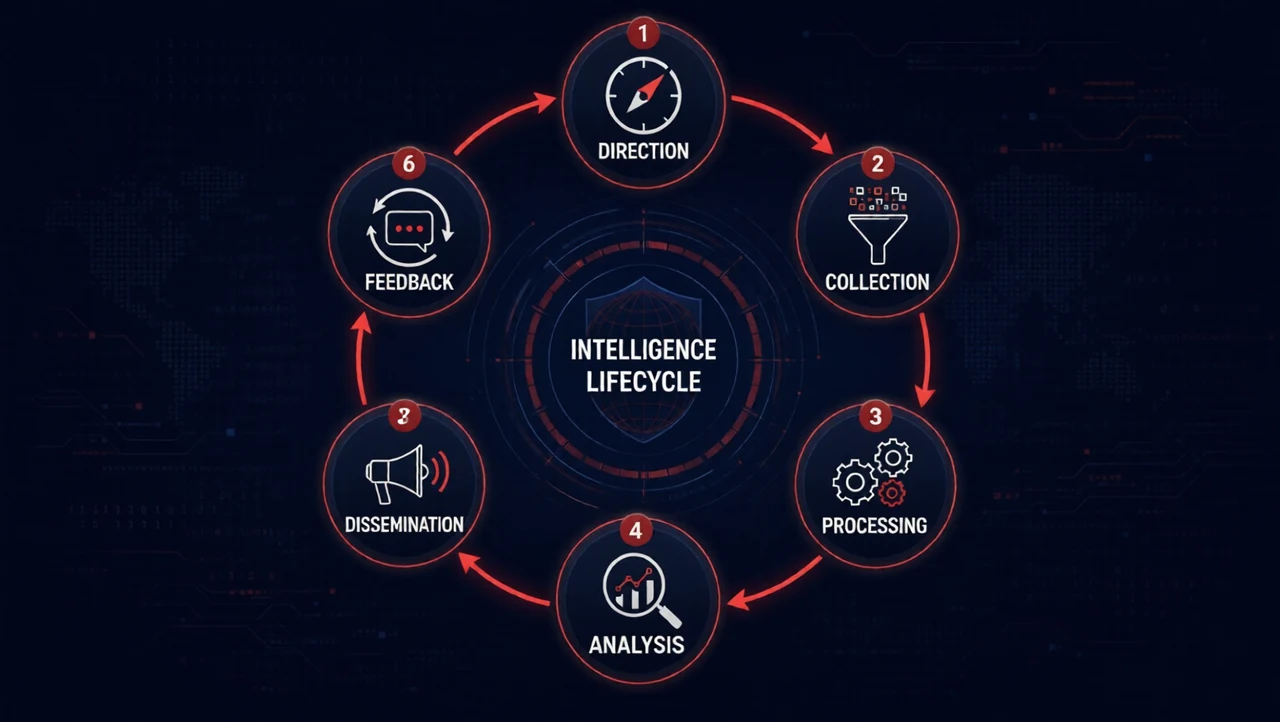
1. Direction (Planning and Requirements)
This phase defines what intelligence needs to be produced and for whom. Analysts work with stakeholders, executives, incident responders, and threat hunters, to identify priority intelligence requirements (PIRs). A financial institution might need intelligence on threat groups targeting SWIFT banking systems, while a healthcare organization might prioritize ransomware groups known to target hospitals.
2. Collection
Once requirements are defined, analysts gather raw data from a variety of sources: open-source intelligence (OSINT), commercial threat feeds, dark web monitoring, information sharing communities (ISACs), internal telemetry from SIEMs and EDR tools, and human intelligence sources. The breadth and quality of collection directly shapes the quality of the final product.
3. Processing
Raw data rarely arrives in a usable format. Processing means normalizing, deduplicating, translating, decrypting, and structuring collected data so it can be analyzed: converting malware samples into behavioral reports, parsing log files, or translating foreign-language forum posts. Automation tools and STIX/TAXII standards play a significant role at this stage.
4. Analysis
This is the heart of the intelligence cycle. Analysts evaluate processed data to identify patterns, attribute activity to threat actors, assess the significance of threats, and produce judgments. Good analysis goes beyond listing indicators: it answers the "so what?" question. Techniques include structured analytic methods, link analysis, temporal pattern analysis, and hypothesis testing. This is where the analyst's expertise matters most.
5. Dissemination
Finished intelligence must reach the right people in the right format at the right time. A strategic assessment for the CISO looks very different from a tactical report for SOC analysts. Common formats include written reports, briefings, machine-readable indicator feeds, and dashboard updates. The best intelligence in the world is useless if it never reaches the people who need it.
6. Feedback
Stakeholders provide feedback on whether the intelligence met their needs, and that feedback feeds back into the direction phase. Did the report help the incident response team? Was the threat assessment relevant to the organization's risk profile? This continuous loop keeps the intelligence program improving and aligned with organizational priorities.
Types of Threat Intelligence
Not all intelligence serves the same purpose. CTI is typically categorized into four types based on the audience and how it will be used.
- Strategic Intelligence gives high-level analysis of trends, motivations, and risks for executive leadership and decision-makers. It answers questions like "How is the threat landscape evolving for our industry?" and usually takes the form of written assessments, risk reports, and briefings. It requires minimal technical depth but strong analytical thinking.
- Tactical Intelligence focuses on the tactics, techniques, and procedures (TTPs) used by threat actors. It helps security teams understand how attacks are carried out so they can improve detection rules, update security controls, and train analysts. Frameworks like MITRE ATT&CK are central to tactical intelligence work.
- Operational Intelligence covers the who, what, when, and how of a specific impending or ongoing attack. It is time-sensitive and often requires access to closed sources, such as dark web forums or private intelligence-sharing groups.
- Technical Intelligence consists of specific, machine-consumable indicators of compromise (IOCs) such as malicious IP addresses, domain names, file hashes, email addresses, and YARA rules. It has a short shelf life since attackers frequently change their infrastructure, but it is essential for automated blocking and detection at scale.
A mature CTI program produces all four types and tailors outputs to the needs of different stakeholders across the organization. Knowing which type fits which audience is one of the most important skills a CTI analyst can develop.
The Cyber Threat Landscape
To produce useful intelligence, analysts must understand the threat landscape: the ecosystem of actors, motivations, and attack methods that define the current environment.
Threat Actor Categories
- Nation-State Actors: Government-sponsored or government-affiliated groups conducting espionage, sabotage, or influence operations. Examples include APT28 (Russia), APT41 (China), and Lazarus Group (North Korea), the name most headlines reached for after the $387.5M Bitget hack in September 2026. These actors are typically well-resourced, patient, and highly capable, and they often target government agencies, defense contractors, critical infrastructure, and research institutions.
- Advanced Persistent Threats (APTs): The term overlaps with nation-state actors, but APTs are defined by their methodology: long-term, stealthy campaigns aimed at maintaining persistent access to target networks, often using custom malware, zero-day exploits, and social engineering.
- Cybercriminals: Financially motivated actors ranging from individual fraudsters to organized crime syndicates operating ransomware-as-a-service (RaaS) platforms. Groups like LockBit and BlackCat have turned cybercrime into a sophisticated industry with affiliate programs, customer support, and negotiation services.
- Hacktivists: Ideologically motivated actors who use cyber attacks to promote political or social causes, typically through website defacement, DDoS attacks, and data leaks. They are generally less sophisticated than nation-state actors but can still cause significant reputational damage.
- Insider Threats: Employees, contractors, or partners who misuse their authorized access, intentionally or through negligence. Insider threats are hard to detect because the activity comes from legitimate accounts and often bypasses perimeter defenses.
Common Attack Types
The threat landscape spans a wide range of attack methods, from phishing and business email compromise (BEC) to supply chain attacks, ransomware, and zero-day exploitation. Understanding these attack types, and how different threat actors employ them, is fundamental to producing relevant intelligence. A solid foundation in information security concepts helps put these threats in context.
Key Frameworks: MITRE ATT&CK, Diamond Model, and Cyber Kill Chain
Frameworks give analysts a shared language and a structured approach to describing, analyzing, and communicating about threats. Three frameworks are foundational to CTI work.
MITRE ATT&CK
The MITRE ATT&CK (Adversarial Tactics, Techniques, and Common Knowledge) framework is a comprehensive knowledge base of adversary behavior mapped across the attack lifecycle. It organizes techniques into tactical categories like Initial Access, Execution, Persistence, Privilege Escalation, Defense Evasion, Credential Access, Discovery, Lateral Movement, Collection, Exfiltration, and Impact.
What makes ATT&CK valuable is its specificity. Each technique includes real-world examples, detection guidance, and references to the threat groups known to use it. Analysts use ATT&CK to map observed adversary behavior, identify detection gaps, and communicate findings in a standardized way.
The Diamond Model of Intrusion Analysis
The Diamond Model structures every intrusion event around four core features: Adversary, Infrastructure, Capability, and Victim. By analyzing the relationships between these features, analysts can pivot from a known indicator to discover related activity. If you identify a piece of malware (capability) used against a specific target (victim), you can investigate the infrastructure it communicates with to potentially identify the adversary, and find other victims.
The model is particularly useful for attribution analysis and for structuring investigations, since it forces analysts to think systematically about how the different elements of an intrusion relate to each other.
Lockheed Martin Cyber Kill Chain
The Cyber Kill Chain models an attack as a sequence of seven stages: Reconnaissance, Weaponization, Delivery, Exploitation, Installation, Command and Control (C2), and Actions on Objectives. The key insight is that defenders can disrupt an attack by breaking any single link in the chain.
Some practitioners consider the Kill Chain too linear for modern attacks, which often involve lateral movement and multiple parallel paths, but it remains useful for understanding how an intrusion progresses and where defensive controls should sit. Many organizations use it alongside ATT&CK to get both a sequential and a behavioral view of attacks.
| Framework | Structure | Best For |
|---|---|---|
| MITRE ATT&CK | Matrix of adversary tactics and techniques | Mapping observed behavior and finding detection gaps |
| Diamond Model | Four features: adversary, infrastructure, capability, victim | Attribution and pivoting from one indicator to related activity |
| Cyber Kill Chain | Seven sequential attack stages | Understanding attack progression and where to place defenses |
Intelligence Disciplines in CTI
CTI draws on several intelligence disciplines, each offering different types of information and requiring different collection methods.
- OSINT (Open Source Intelligence): Intelligence gathered from publicly available sources: websites, social media, forums, paste sites, public records, academic papers, and more. OSINT is the backbone of most CTI programs because it is accessible, legal, and abundant, though it requires strong research skills and critical evaluation of sources. Our complete guide to OSINT covers collection techniques, tools, and best practices in depth.
- HUMINT (Human Intelligence): Intelligence gathered through human sources: contacts within threat actor communities, trusted industry peers, law enforcement relationships, or intelligence-sharing partnerships. In the cyber domain, HUMINT might mean cultivating relationships in closed dark web forums or joining information-sharing groups. It raises real ethical and legal considerations; learn more in our HUMINT in cybersecurity guide.
- SIGINT (Signals Intelligence): Intelligence derived from intercepted electronic communications and signals, including network traffic analysis, monitoring command-and-control communications, and analyzing intercepted data transmissions. SIGINT capabilities are typically associated with government intelligence agencies, but commercial CTI teams use related techniques such as passive DNS analysis, netflow monitoring, and honeypot-based collection.
- TECHINT (Technical Intelligence): Intelligence derived from technical analysis of malware, exploits, and attacker tools, including reverse engineering malware samples, analyzing exploit code, and examining the technical characteristics of attacker infrastructure. TECHINT feeds directly into IOCs and behavioral detection signatures.
A well-rounded CTI analyst understands how these disciplines complement each other: an OSINT investigation might reveal a threat actor's online persona, HUMINT might add context about their motivations, SIGINT might expose their infrastructure, and TECHINT might reveal their capabilities. Combining multiple disciplines produces richer, more reliable intelligence.
Operational Security (OPSEC) for Analysts
CTI analysts often interact with adversary infrastructure, browse dark web forums, and research threat actors who are themselves sophisticated operators. Poor operational security can expose the analyst, their organization, and their intelligence sources to risk.
OPSEC fundamentals for CTI analysts include:
- Attribution management: Use dedicated research environments, virtual machines, VPNs, and anonymization tools such as Tor to keep threat actors from identifying you or your organization during investigations. Never research from your corporate network without appropriate isolation.
- Persona separation: Keep a strict separation between your real identity and any research personas, using dedicated email addresses, accounts, and devices for intelligence collection. Do not cross-contaminate personal and professional identities.
- Data handling: Treat collected intelligence data with appropriate sensitivity. Malware samples, stolen credentials found during investigations, and information from closed sources all need careful handling, storage, and access controls.
- Digital footprint awareness: Understand what information about you is publicly available and could be used by adversaries for counter-intelligence. Audit your own digital footprint regularly and minimize unnecessary exposure.
- Need-to-know principle: Share intelligence methods and sources only with those who need access. Protect your collection methods as carefully as you protect the intelligence they produce.
Good OPSEC is not paranoia, it is a professional requirement. Threat actors actively look for researchers investigating them, and a single OPSEC failure can compromise an entire investigation or put colleagues at risk.
Career Paths in CTI
Demand for CTI professionals keeps growing as organizations recognize that intelligence-driven security beats reactive approaches. The primary career paths in the field are:
- CTI Analyst: The core role, covering collection, analysis, and production of intelligence products. Entry-level analysts often start with tactical and technical intelligence (IOC management, threat feed analysis) before moving into operational and strategic analysis.
- Threat Hunter: Uses intelligence to proactively search for undetected threats inside an organization's network, combining CTI knowledge with strong technical skills in log analysis, endpoint forensics, and network analysis.
- Malware Analyst / Reverse Engineer: Focuses on the technical analysis of malware and exploits to extract intelligence about attacker capabilities, infrastructure, and techniques. Requires strong programming and reverse engineering skills.
- Intelligence Manager / CTI Team Lead: Oversees the intelligence program, sets requirements, manages analyst teams, and keeps intelligence products aligned with organizational strategy. Requires both technical depth and strong communication skills.
- Strategic Intelligence Analyst: Produces high-level assessments for executive audiences, analyzing geopolitical trends, industry-specific threat landscapes, and long-term risk scenarios. Often draws on experience in traditional intelligence analysis or international relations.
To enter the field, build a strong foundation in networking, operating systems, and information security fundamentals. Learn the key frameworks, especially MITRE ATT&CK, develop your OSINT skills, and practice writing clear analytical reports. Certifications and formal training can speed up your path, but demonstrated skills and analytical thinking matter most.
How CTI Academy Teaches This
CTI Academy is a hands-on cyber threat intelligence training platform built by practitioners who work as CTI analysts, threat hunters, and security researchers. Instead of slide decks, each learning path combines short lessons and quizzes with case-based missions where you work the concepts in this guide against realistic evidence.
The Cyber Threat Intelligence Learning Path is the core CTI course. It runs from the first intelligence requirement to a defensive handoff: building PIRs, grading sources, using MITRE ATT&CK, the Diamond Model and the Cyber Kill Chain, tracking actors and campaigns, and writing assessments a SOC or incident response team can act on. Related disciplines each have their own path:
- Cybersecurity Foundations: the security and Linux basics every other path assumes, if you are starting with no security background.
- Open Source Intelligence (OSINT): collection planning, search, verification, evidence handling and research OPSEC.
- Human Source Collection for CTI: HUMINT tradecraft, from grading a source to running a research persona.
- Attack Surface Management: mapping an organization's external footprint and turning it into a prioritized remediation queue.
- Threat Actor Profiling & Attribution: weighing evidence about an activity cluster and stating confidence you can defend.
Every path ends in a verifiable certificate. The platform is built for two groups: people with no security background who want to start a CTI career, and SOC analysts or security professionals who already work in the field and want practical, hands-on training rather than theory-only courses.
Frequently Asked Questions
What is Cyber Threat Intelligence (CTI) in simple terms?
CTI is analyzed, evidence-based knowledge about cyber threats that helps organizations anticipate, prevent, and respond to attacks. It differs from raw threat data by adding context: who the attacker is, what they want, and how they operate.
What are the four types of threat intelligence?
Strategic, tactical, operational, and technical. Strategic serves executives with trend and risk analysis, tactical covers attacker TTPs, operational covers specific ongoing or planned attacks, and technical covers machine-readable indicators of compromise.
What are the six phases of the CTI intelligence lifecycle?
Direction, collection, processing, analysis, dissemination, and feedback. Each phase turns raw threat information into a finished product tailored to a specific audience.
What frameworks do CTI analysts use most?
MITRE ATT&CK for mapping adversary techniques, the Diamond Model for structuring intrusion analysis, and the Cyber Kill Chain for modeling the stages of an attack.
Is Cyber Threat Intelligence a good career path?
Yes. Demand for CTI professionals is growing as organizations move from reactive to intelligence-driven security. Entry points include CTI analyst, threat hunter, malware analyst, and strategic intelligence roles.
How does CTI Academy teach Cyber Threat Intelligence?
Through hands-on learning paths built by practitioners. The Cyber Threat Intelligence Learning Path is the core course, with separate paths for OSINT, HUMINT, attack surface management and threat actor profiling. Each one combines lessons, quizzes and case-based missions, and ends in a verifiable certificate.
Key Takeaway
CTI is a rapidly growing field with diverse career paths. Whether you are drawn to hands-on technical analysis or strategic advisory roles, the foundation stays the same: strong analytical thinking, solid technical knowledge, and a systematic approach to understanding threats.