
1. What is Attack Surface Management?
Attack Surface Management (ASM) is the continuous process of discovering, cataloging, and securing all internet-facing assets that an attacker could target. Unlike traditional vulnerability management that focuses on known assets, ASM starts from the attacker's perspective, identifying assets your organization may not even realize are exposed.
An organization's attack surface consists of every digital touchpoint where an unauthorized user could attempt to enter or extract data. This includes two primary categories:
| Category | What It Includes |
|---|---|
| External Attack Surface | Public-facing assets: web applications, APIs, DNS records, cloud infrastructure, email servers, VPN gateways, and exposed network services visible from the internet |
| Internal Attack Surface | Systems reachable within the corporate network: internal applications, databases, file shares, and lateral movement paths relevant once perimeter defenses are breached |
ASM has become critical in today's security landscape for several converging reasons. The rapid adoption of cloud services means organizations now operate across multiple providers, each with its own configuration surface. Remote work has expanded the perimeter beyond the traditional office network, with employees accessing resources from personal devices and home networks. Perhaps most concerning is the rise of shadow IT, where teams spin up cloud instances, SaaS tools, and development environments without security oversight, creating blind spots that attackers eagerly exploit.
According to industry research, the average enterprise has 30 to 40 percent more assets exposed to the internet than their security teams are aware of, which is why Gartner tracks External Attack Surface Management as its own market category. Every unknown asset is a potential entry point for an attacker. ASM closes that visibility gap by providing a continuous, outside-in view of your organization's digital footprint.
Key Takeaway
ASM shifts the security paradigm from defending known assets to discovering all assets, including those your organization has forgotten or never knew existed. You cannot protect what you cannot see.
2. The ASM Lifecycle
Effective attack surface management is not a one-time audit but a continuous cycle with five interconnected phases. Each phase feeds into the next, creating a feedback loop that adapts to your organization's constantly changing digital footprint.
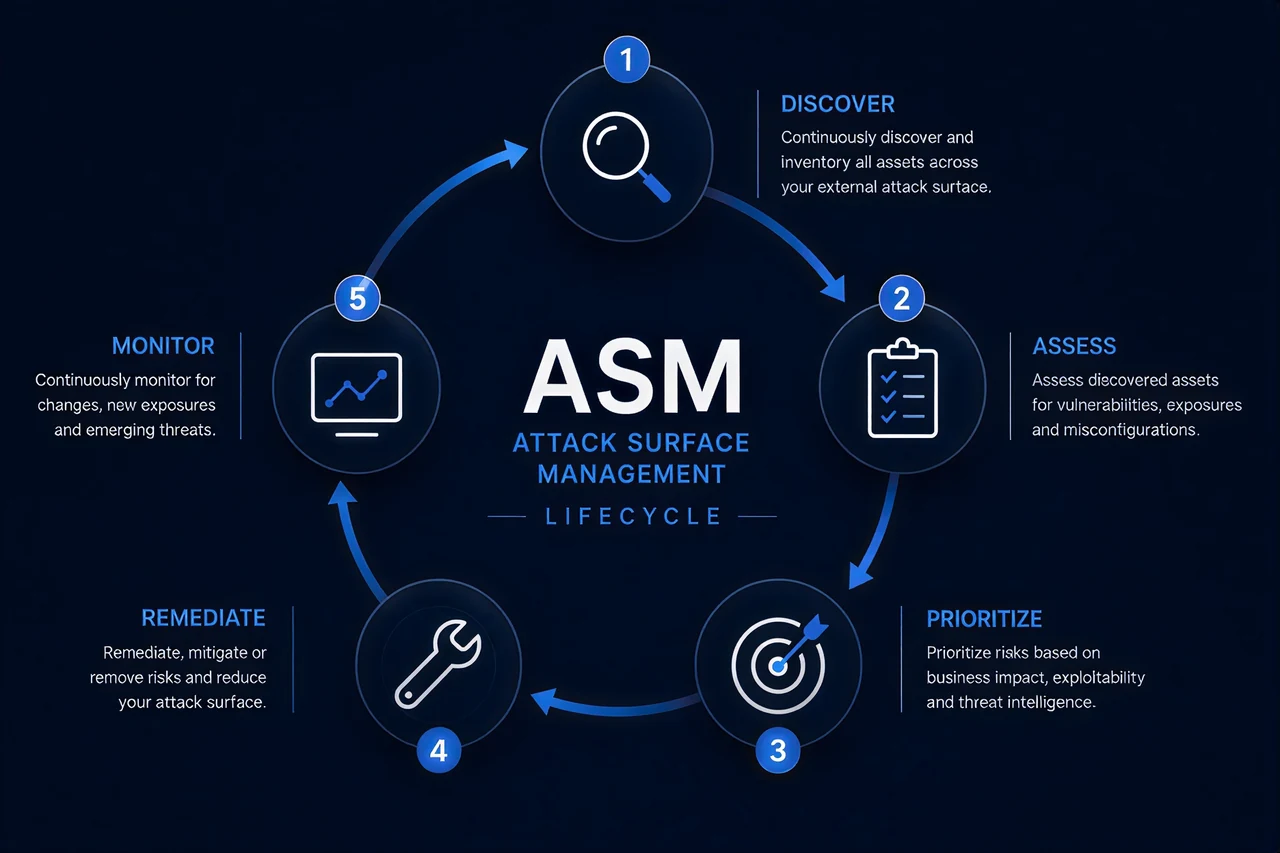
Discover
The discovery phase maps all externally facing assets associated with your organization. This includes domains, subdomains, IP addresses, cloud instances, third-party services, and any infrastructure that can be linked back to your organization through WHOIS records, DNS configurations, ASN ownership, or certificate transparency logs. Automated discovery tools scan continuously because new assets appear every time a developer deploys a service or a team adopts a new SaaS platform.
Assess
Once assets are discovered, each one must be assessed for security posture. This involves identifying running services, software versions, misconfigurations, exposed credentials, deprecated protocols, and known vulnerabilities. The assessment phase transforms a raw inventory into actionable intelligence about where weaknesses exist.
Prioritize
Not all vulnerabilities carry equal risk. Prioritization combines technical severity (CVSS scores, exploit availability) with business context (asset criticality, data sensitivity, regulatory requirements). A misconfigured staging server hosting test data presents a different risk profile than an exposed production database containing customer records.
Remediate
Remediation actions range from patching software and correcting configurations to decommissioning forgotten assets entirely. The most effective ASM programs integrate remediation workflows with existing ticketing systems and DevOps pipelines so that fixes are tracked, assigned, and verified.
Monitor
The monitoring phase closes the loop. Continuous monitoring detects new assets as they appear, identifies configuration drift, tracks remediation progress, and alerts on newly disclosed vulnerabilities affecting your asset inventory. This phase feeds directly back into discovery, making ASM a perpetual cycle rather than a project with a defined end date.
3. Reconnaissance & OSINT Fundamentals
Reconnaissance is the foundation of attack surface management. Before you can secure your perimeter, you need to see it the way an attacker does. Open Source Intelligence (OSINT) techniques provide the methodology for gathering this information from publicly available sources without directly interacting with target systems.
Passive vs. Active Reconnaissance
Passive reconnaissance involves collecting information without sending any traffic to the target. This includes querying public databases, analyzing cached data, reviewing social media, and examining historical records. Passive recon is undetectable by the target because there is no direct interaction.
Active reconnaissance involves directly interacting with the target's systems, such as port scanning, banner grabbing, or sending crafted requests. While more thorough, active recon generates network traffic that may be logged or trigger security alerts.
DNS Enumeration
DNS records are a goldmine for ASM. Querying A, AAAA, MX, TXT, NS, CNAME, and SRV records reveals the infrastructure behind a domain. Zone transfers (AXFR), when misconfigured, can expose the entire DNS zone. Even when zone transfers are blocked, iterative querying and dictionary-based enumeration can uncover subdomains and service endpoints.
WHOIS and Registration Data
WHOIS databases provide domain registration details including registrant information, name servers, and registration dates. Cross-referencing registrant email addresses or organization names across WHOIS records can reveal related domains and infrastructure that belong to the same entity.
Certificate Transparency Logs
Certificate Transparency (CT) logs are publicly auditable records of every SSL/TLS certificate issued by participating Certificate Authorities. Querying CT logs through services like crt.sh reveals all certificates issued for a domain, including subdomains that may not appear in DNS enumeration. This technique frequently uncovers internal hostnames, staging environments, and development servers that were never intended to be public.
Search Engine Dorking
Advanced search operators (Google dorks) can identify exposed files, login portals, directory listings, error messages, and configuration files indexed by search engines. Queries like site:example.com filetype:pdf or intitle:"index of" site:example.com can surface sensitive information that was inadvertently made accessible.
4. Subdomain Discovery Techniques
Subdomains are one of the largest and most commonly overlooked components of an organization's attack surface. Each subdomain potentially runs different software, is maintained by a different team, and may have a completely different security posture than the main domain.
Automated Discovery Tools
Amass by OWASP is one of the most comprehensive subdomain enumeration tools available. It combines passive data collection from dozens of sources (search engines, certificate transparency, DNS datasets, web archives) with active DNS brute-forcing and permutation scanning. Its graph database capability maps the relationships between discovered assets.
Subfinder is a fast, passive subdomain discovery tool that queries over 40 data sources. It excels at speed and reliability, making it ideal for integrating into automated ASM pipelines. Used in combination with Amass, it provides thorough coverage of an organization's subdomain landscape.
Certificate Transparency Monitoring
Beyond one-time queries, continuous CT log monitoring alerts you whenever a new certificate is issued for your domain. This provides near-real-time notification of new subdomains, whether created by your organization or potentially by an attacker who has compromised your domain or obtained a fraudulent certificate.
DNS Brute-Forcing
Dictionary-based DNS brute-forcing tests thousands of common subdomain names against the target domain. Effective wordlists combine generic terms (dev, staging, api, admin, vpn, mail) with organization-specific terminology derived from the reconnaissance phase. Tools like massdns enable high-speed resolution of millions of potential subdomains.
Permutation Scanning
Permutation scanning generates variations of known subdomains to discover related hosts. If api.example.com exists, permutation tools will test api-v2.example.com, api-staging.example.com, api-test.example.com, and hundreds of similar patterns. Tools like altdns and dnsgen automate this process.
Finding Forgotten and Orphaned Subdomains
Orphaned subdomains present severe risks. A subdomain that once pointed to a cloud service your organization no longer uses may be vulnerable to subdomain takeover, where an attacker registers the unclaimed service endpoint and serves malicious content under your domain. Regular auditing of DNS records against active infrastructure is essential. Historical DNS data from sources like SecurityTrails and passive DNS databases helps identify subdomains that have gone stale.
5. Infrastructure Discovery & Passive Scanning
Once domains and subdomains are mapped, the next step is understanding what services run on the discovered infrastructure. Passive scanning leverages internet-wide scan databases to gather this intelligence without sending a single packet to the target.
Shodan
Shodan continuously scans the entire IPv4 address space and indexes the banners returned by internet-facing services. Searching for your organization's IP ranges, domain names, or SSL certificate fingerprints reveals exposed services including web servers, databases, IoT devices, industrial control systems, and remote access services. Shodan queries like ssl.cert.subject.cn:"example.com" find all hosts presenting certificates for your domain.
Censys
Censys provides a similar internet-wide scanning capability with a focus on structured data and certificate analysis. Its search interface allows filtering by protocol, port, software version, and geographic location. Censys is particularly strong for identifying hosts based on certificate attributes, making it valuable for discovering infrastructure linked to your organization through its PKI.
Identifying Infrastructure Components
Through passive scanning databases, ASM practitioners can identify:
- Web servers and their technologies (Apache, Nginx, IIS), including version numbers and sometimes loaded modules
- Mail servers (SMTP, IMAP, POP3) and their configurations, including whether encryption is enforced
- VPN endpoints and remote access services (OpenVPN, WireGuard, RDP, SSH) that could be brute-forced or exploited
- Database services (MySQL, PostgreSQL, MongoDB, Elasticsearch) that should never be directly exposed to the internet
- API endpoints and development tools (Jenkins, GitLab, Kubernetes dashboards) that may lack proper authentication
The advantage of passive scanning is that it reveals your exposure without alerting monitoring systems or generating potentially unauthorized network traffic. For ASM purposes, passive scanning provides the bulk of the information needed to assess external exposure.
6. Cloud Attack Surface
Cloud infrastructure has dramatically expanded the modern attack surface. Organizations using AWS, Azure, and GCP face unique risks stemming from the shared responsibility model, where the cloud provider secures the infrastructure but the customer is responsible for configuring services securely.
AWS S3 Bucket Misconfigurations
Misconfigured S3 buckets remain one of the most common cloud security failures. Buckets set to public access, overly permissive bucket policies, and ACLs granting access to "All Users" or "Authenticated Users" have led to countless data breaches. ASM tools scan for publicly accessible buckets by testing common naming patterns derived from the target organization's name, products, and known infrastructure.
Azure Blob Storage Exposure
Azure Blob Storage containers share similar misconfiguration risks. Publicly accessible containers, shared access signatures (SAS) with overly broad permissions, and storage accounts without network restrictions can expose sensitive data. Enumeration of Azure storage accounts follows patterns like https://[company]storage.blob.core.windows.net and common variations.
GCP Asset Discovery
Google Cloud Platform resources including Cloud Storage buckets, BigQuery datasets, and Firebase databases can be inadvertently exposed. GCP's uniform bucket-level access simplifies permissions but misconfigurations still occur, particularly with legacy ACL settings and overly permissive IAM bindings.
Cloud IP Range Identification
Cloud providers publish their IP ranges (AWS publishes its ranges as a JSON file, Azure and GCP similarly). Mapping your organization's cloud footprint involves correlating discovered IP addresses against these published ranges to identify which cloud services are in use and whether assets exist in unexpected regions or accounts.
Serverless Function Risks
Serverless functions (AWS Lambda, Azure Functions, Google Cloud Functions) introduce attack surface through their HTTP triggers, event sources, and IAM roles. Over-permissioned execution roles, exposed function URLs without authentication, and dependency vulnerabilities in function code all contribute to the cloud attack surface that traditional scanning often misses.
7. Continuous Monitoring & Risk Prioritization
A point-in-time assessment is valuable but insufficient. Organizations change their digital footprint daily as teams deploy new services, update configurations, adopt new tools, and decommission old systems. Continuous monitoring transforms ASM from a periodic audit into an always-on security capability.
Asset Inventory Management
An accurate, continuously updated asset inventory is the foundation of effective ASM. Every discovered asset should be tagged with ownership information, business function, data classification, and technology stack. This inventory serves as the authoritative source of truth for your external attack surface and must be kept current through automated discovery and manual validation.
Change Detection
Monitoring for changes across your attack surface alerts security teams to new risks as they emerge. This includes new subdomains appearing, services changing ports, TLS certificates expiring, new technologies being deployed, and DNS records being modified. Effective change detection distinguishes between expected changes (planned deployments) and unexpected changes (potentially unauthorized modifications).
Vulnerability Scoring
Raw CVSS scores provide a starting point for vulnerability prioritization, but effective ASM programs layer additional context. Factors such as exploit availability in the wild, whether the vulnerability is being actively exploited (KEV catalog), the asset's internet exposure level, and compensating controls all influence the actual risk a vulnerability presents to your organization.
Business Impact Assessment
Technical severity must be weighed against business impact. A medium-severity vulnerability on a system processing payment data may warrant faster remediation than a critical vulnerability on an isolated test server. Aligning ASM risk scores with business criticality ensures that remediation efforts focus on protecting the organization's most valuable assets and processes.
8. ASM Tools & Platforms
The ASM market includes both commercial platforms that provide turnkey solutions and open-source tools that offer flexibility and customization. An effective ASM program typically combines multiple tools to achieve comprehensive coverage.
Commercial Platforms
- Mandiant Advantage Attack Surface Management: Enterprise-grade discovery with threat intelligence integration and deep analysis capabilities
- Microsoft Defender External Attack Surface Management: Integrates with the Microsoft security ecosystem and provides continuous asset discovery
- Palo Alto Cortex Xpanse: Real-time internet-wide scanning with automated attribution of assets to organizations
- CrowdStrike Falcon Surface: Combines ASM with threat intelligence for adversary-focused attack surface visibility
Open-Source Tools
- Amass (OWASP): Comprehensive subdomain enumeration and network mapping with graph analysis
- Subfinder: Fast passive subdomain discovery from multiple data sources
- Nuclei: Template-based vulnerability scanning for validating discovered attack surface
- httpx: HTTP probing tool for identifying live web servers and capturing metadata
- Shodan CLI / Censys CLI: Command-line interfaces for querying internet-wide scan databases
The choice between commercial and open-source depends on your organization's size, budget, and in-house expertise. Many teams start with open-source tools to build foundational capabilities and later adopt commercial platforms as their ASM program matures and scale becomes important.
9. Building an ASM Program
Implementing ASM as an organizational capability requires more than deploying tools. A successful program addresses people, processes, and technology in a coordinated approach.
Organizational Considerations
Define clear ownership for the ASM program. Determine where it sits within the security organization, whether in the vulnerability management team, the threat intelligence team, or as a dedicated function. Establish communication channels with IT operations, DevOps, cloud engineering, and business units who create and manage the assets you are discovering. Cross-functional collaboration is essential because the ASM team discovers assets but typically does not own or operate them.
Integration with Vulnerability Management
ASM and vulnerability management are complementary disciplines. ASM discovers the assets; vulnerability management assesses and remediates the weaknesses on those assets. Integrate your ASM asset inventory with vulnerability scanners to ensure complete coverage. Assets discovered by ASM that are missing from your vulnerability scanner's scope represent your highest-risk blind spots.
Integration with Threat Intelligence
Correlating ASM findings with cyber threat intelligence adds an adversary perspective, and CISA's exposure reduction guidance is a good free starting point for building this practice. If threat intelligence indicates that a specific threat group is targeting a vulnerability in software you have exposed on the internet, that finding warrants immediate escalation. Similarly, monitoring for your organization's assets appearing in underground forums, paste sites, or leaked credential databases enhances the value of both programs.
Metrics and KPIs
Measure the effectiveness of your ASM program with quantifiable metrics:
- Total discovered assets versus known/managed assets (visibility gap)
- Mean time to discovery of new assets appearing on the internet
- Mean time to remediation of critical findings
- Shadow IT discovery rate: number of unknown assets discovered per assessment cycle
- Attack surface reduction trend: tracking the total attack surface area over time
- Coverage ratio: percentage of discovered assets included in vulnerability scanning and security monitoring
These metrics demonstrate program value to leadership and guide continuous improvement. A mature ASM program should show a shrinking visibility gap and decreasing mean time to discovery as processes and automation improve.
To practice the whole cycle rather than read about it, the Attack Surface Management Learning Path is a hands-on ASM course: you discover an organization's external footprint through DNS, WHOIS, certificate transparency and cloud storage, check what a scan actually proves, and turn the raw asset list into a prioritized, owner-assigned remediation queue.
Frequently Asked Questions
What is Attack Surface Management (ASM)?
ASM is the continuous process of discovering, cataloging, and securing every internet-facing asset an attacker could target, including assets an organization does not know it has. It starts from the attacker's outside-in perspective rather than a known asset inventory.
What are the five phases of the ASM lifecycle?
Discover, assess, prioritize, remediate, and monitor. The cycle is continuous: monitoring feeds directly back into discovery as new assets appear.
What is the difference between ASM and vulnerability management?
ASM discovers what assets exist, including unknown or forgotten ones. Vulnerability management assesses and remediates weaknesses on assets that are already known. The two disciplines are complementary and work best integrated together.
What tools are used for subdomain discovery?
Amass and Subfinder are widely used open-source tools. Amass combines passive data collection with active DNS brute-forcing and permutation scanning, while Subfinder focuses on fast, passive discovery across many data sources.
What is subdomain takeover?
Subdomain takeover happens when a subdomain still points to a cloud service or resource an organization no longer controls. An attacker can register that unclaimed endpoint and serve malicious content under the victim's own domain.
Key Takeaway
ASM is not a product you buy but a capability you build. Start by gaining visibility into your external attack surface, prioritize findings based on business risk, and continuously improve your processes. The goal is to discover and secure assets faster than attackers can find and exploit them.