
In 2022, the median time between an attacker breaking into a network and handing that access off to a ransomware crew was more than eight hours. In 2025 it was 22 seconds. That figure comes from Mandiant's M-Trends 2026 report, built on over 500,000 hours of frontline incident response, and it tells you almost everything you need to know about why this job exists.
Someone has to study that collapse. Someone has to name the initial access broker who sold the door, map the affiliate who walked through it, and warn the next hundred organizations before they become the next headline. That someone is a cyber threat intelligence analyst.
If you are wondering how to become a CTI analyst in 2026, this guide is the full roadmap, built by pulling apart real job postings and certification requirements rather than paraphrasing the last five articles on this topic. Not the recruiter version with a stock photo of a hoodie and a padlock, but the version an analyst would actually give you: what the work is, whether it pays, what you need to learn, which certifications matter and in what order, and how to get through the door when every posting seems to want three years of experience you do not have yet.
TL;DR
- CTI analysts turn raw attacker data into decisions defenders can act on, working at tactical, operational, or strategic altitude.
- Demand is strong: a 4.8 million-person global talent gap and 33% projected growth for information security analysts through 2034.
- Realistic 2026 U.S. pay: $65K-$85K entry, $95K-$130K mid-level, $130K-$175K+ senior.
- No degree required for most commercial roles; a portfolio of written analysis and a SOC analyst on-ramp matter more than a diploma.
- Certify in order: Security+, then CySA+ or BTL1, then CTIA, and only later GCTI. Plan on 12 to 24 months to reach genuine competence.
What a Cyber Threat Intelligence Analyst Actually Does
Threat intelligence is the discipline of turning raw data about attackers into decisions defenders can act on. That is the whole job in one sentence, but the sentence hides a lot.
The confusion usually starts with the word "intelligence." People assume it means collecting indicators of compromise, IP addresses, file hashes, malicious domains, and dumping them into a feed. That is data, not intelligence. A hash tells you a file was bad once. Intelligence tells you which group is likely to target your sector next quarter, how they get in, and what you should fix first. The gap between those two things is where an analyst earns their salary.
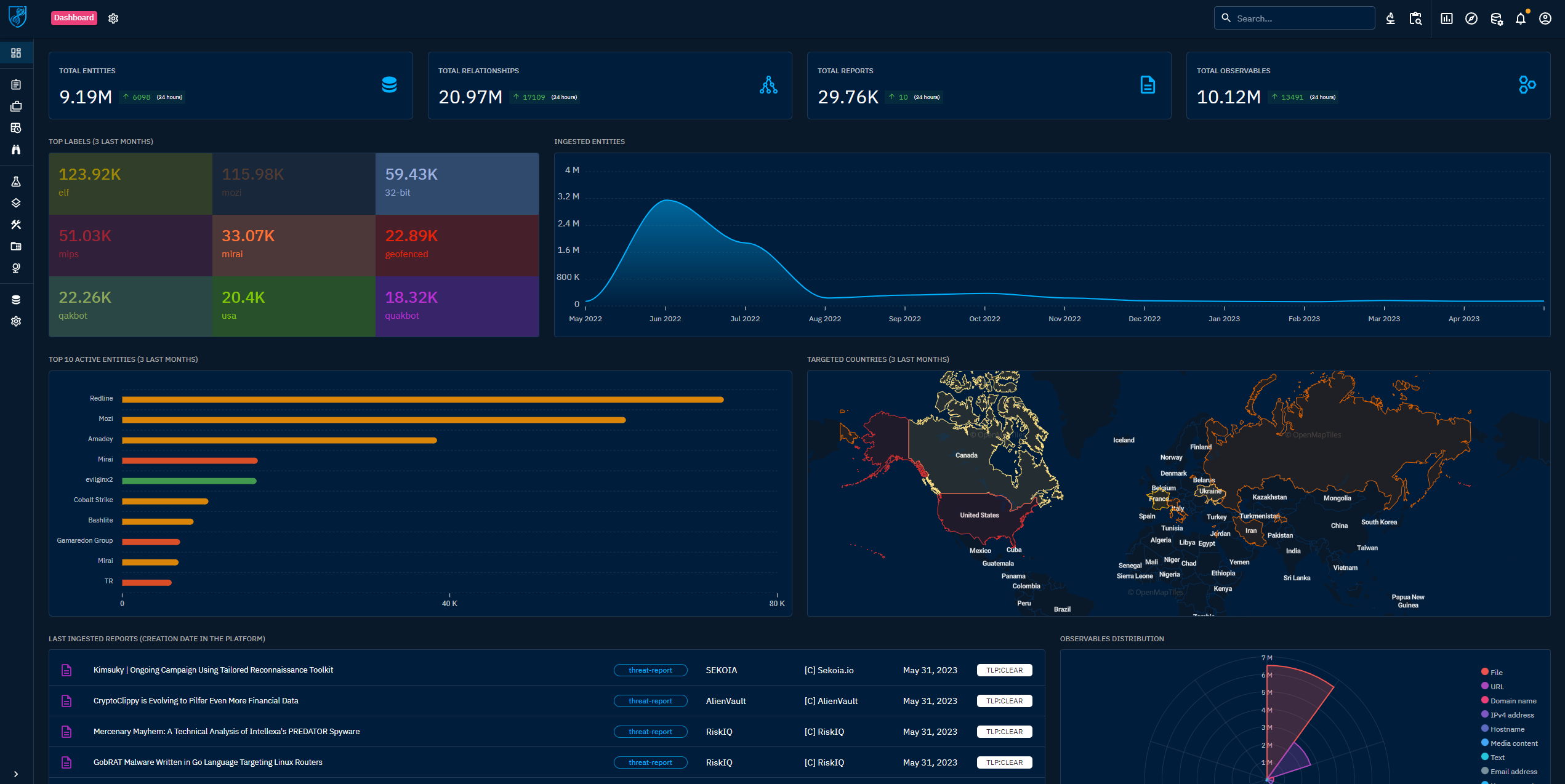
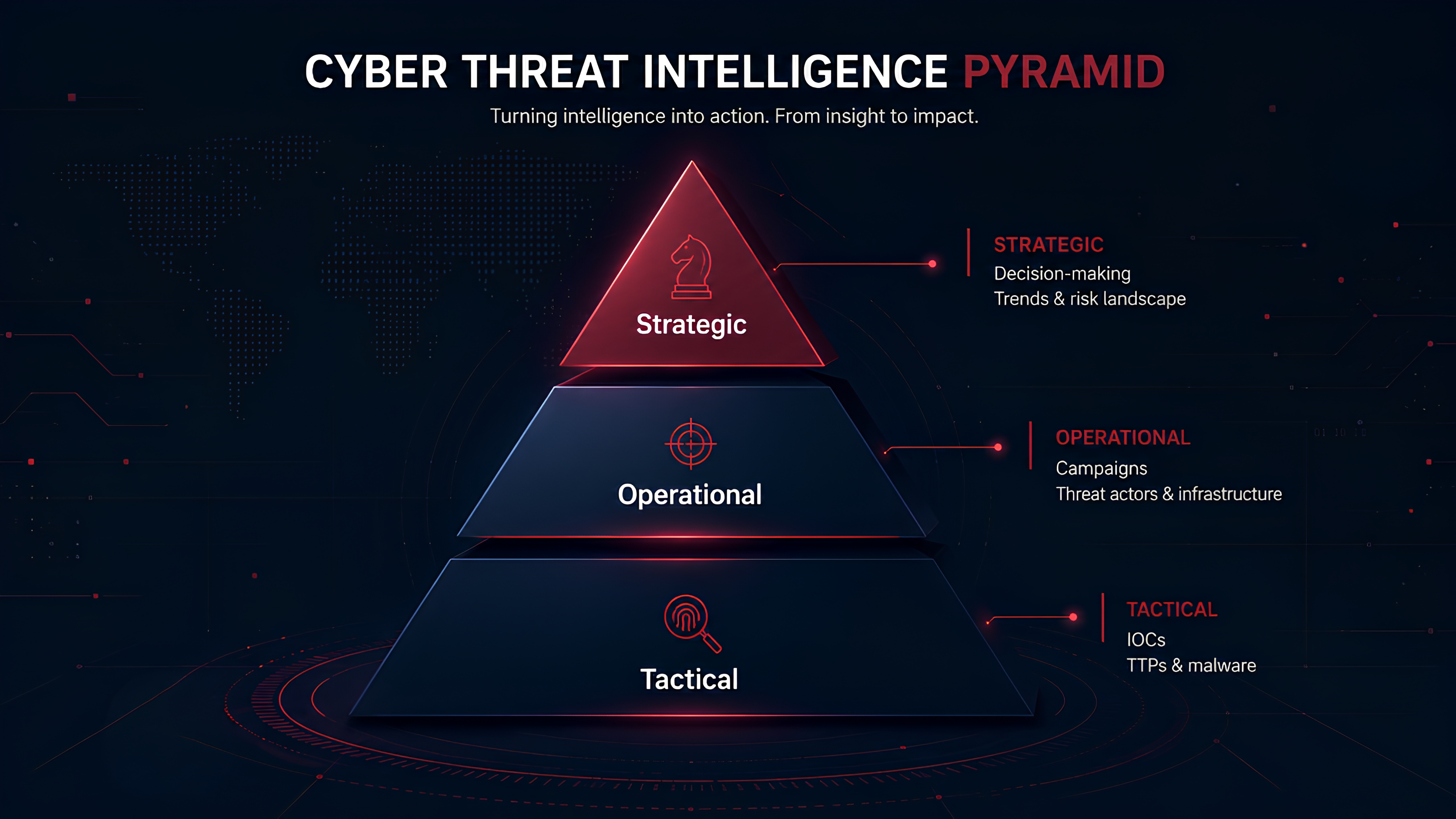
The work sits at three altitudes, and understanding them early will save you from a lot of mismatched job applications.
Tactical intelligence is the closest to the ground. Indicators, malware behavior, detection rules, the artifacts a SOC consumes to catch something today. If you enjoy pulling apart a phishing kit or writing a Sigma rule, this is your neighborhood.
Operational intelligence is about campaigns and adversary behavior over time. Who is Scattered Spider targeting this month, what does their social engineering playbook look like, how do they pivot once they are in. This is TTP-level work, and it leans hard on frameworks like MITRE ATT&CK.
Strategic intelligence is the boardroom altitude. Geopolitical risk, sector-wide trends, where the threat landscape is heading, written for people who control budgets and do not care about a JARM hash. Mandiant's finding that cyber espionage clusters doubled their share of observed activity in 2025, or that North Korean IT workers using fake identities held a median dwell time of 122 days, is strategic intelligence. It changes hiring policy and vendor selection, not firewall rules.
Most analysts live in one or two of these altitudes and touch the others. A junior role is almost always tactical or operational. Strategic work tends to come with seniority, because it requires judgment you can only build by being wrong a few hundred times first.
Day to day, the job is less glamorous and more disciplined than people expect. You read a lot. You correlate messy, conflicting data from open sources, vendor reports, internal telemetry, and sometimes underground forums. You test your own assumptions before you commit them to a report. Then you write, because intelligence nobody reads or acts on is just an expensive hobby. The writing is not a side task. It is the deliverable.
Is It Worth Becoming a CTI Analyst in 2026?
Short answer: yes, and the numbers back it up. Longer answer: yes, if you understand what you are actually signing up for.
Start with demand. ISC2's workforce research continues to put the global cybersecurity talent gap around 4.8 million unfilled roles, and roughly three quarters of organizations report an active shortage of security staff. That is the macro picture. Zoom into threat intelligence specifically and it looks even better for a newcomer. The U.S. Bureau of Labor Statistics projects 33 percent growth for information security analysts between 2024 and 2034, which is far above the average for all occupations. CyberSeek data tracks well over 470,000 open security positions in the United States alone. And when one industry tracker broke growth down by role, cyber threat intelligence analyst postings grew by more than 14 percent year over year, one of the fastest-growing specializations in the field. Threat intelligence and threat hunting now show up in roughly 37 percent of security job listings.
So the field wants people. Does it pay?
Here the honest answer requires a caveat, because salary figures for this exact title scatter wildly depending on who is counting and what they call the role. The Bureau of Labor Statistics puts the median for information security analysts at around $124,910 as of its May 2024 data, with the top ten percent earning well above $186,000. Aggregators that track the specific "cyber threat intelligence analyst" title land lower on base pay, ZipRecruiter reported an average near $110,000 in 2026, while Glassdoor's estimate of total compensation including bonuses ran considerably higher, in the $150,000s at the median. Treat any single number with suspicion. The useful takeaway is the shape of the curve, not the decimal points.
Broken down by experience, a realistic 2026 picture in the U.S. market looks roughly like this:
| Level | Experience | Typical U.S. range (base) |
|---|---|---|
| Entry / Junior | 0 to 2 years | $65,000 to $85,000 |
| Mid-level | 3 to 5 years | $95,000 to $130,000 |
| Senior | 6 to 10 years | $130,000 to $175,000 |
| Lead / Principal | 10+ years | $170,000 to $220,000+ |
Outside the U.S. the absolute figures drop, sometimes sharply, but the demand pattern holds across most mature markets. The UK, Germany, France, and the Netherlands all show strong hiring, driven partly by regulatory pressure. Remote-friendly employers have also widened the pool, which is good news if you are not sitting in Virginia or California.
One question hangs over every cybersecurity career conversation right now, so let me address it directly. Is AI going to take this job? No, and the data actually points the other way. Automation is compressing the routine end of security work, Tier 1 alert triage is being handed to machines, which is squeezing the lowest-skill roles. But the same trend increases demand for people who can interpret, direct, and validate what those systems produce. M-Trends 2026 documented attackers using large language models mid-execution to evade detection and credential stealers like QUIETVAULT hunting for local AI tooling. Adversaries are getting AI. Defense needs analysts who understand it. The bar is rising, not disappearing.
Do You Need a Degree to Become a CTI Analyst?
You do not need one to do the work well. Whether you need one to get hired depends entirely on where you apply.
A computer science or cybersecurity degree helps, mostly because it front-loads the fundamentals and gives HR filters an easy box to tick. But the field is unusually open to non-traditional paths, and the industry has been saying so out loud for years, largely because the traditional pipeline cannot fill 4.8 million empty chairs on its own. Career changers, veterans, self-taught practitioners, and people crossing over from IT are all normal here.
Two categories of employer are the exception. Government and defense contractor roles, especially in the U.S., frequently mandate a specific baseline like CompTIA Security+ under the old DoD 8570 directive, and often require a security clearance that can take months to process. If a cleared government CTI role is your target, plan for that runway early. For most commercial roles, though, a portfolio that proves you can think and write like an analyst will outrun a diploma that proves you sat in a room for four years.
The single most common route into CTI is not a degree at all. It is a lateral move. You start in a security operations center as a SOC analyst, you learn what an alert looks like at three in the morning, how incidents escalate, what real attacker behavior looks like in real logs, and then you pivot into intelligence. Hiring managers trust that path because it means you understand the customer you are writing for. Other common on-ramps include IT help desk or sysadmin work, and for the technically inclined, reverse engineering or malware analysis.
The Skills You Actually Need
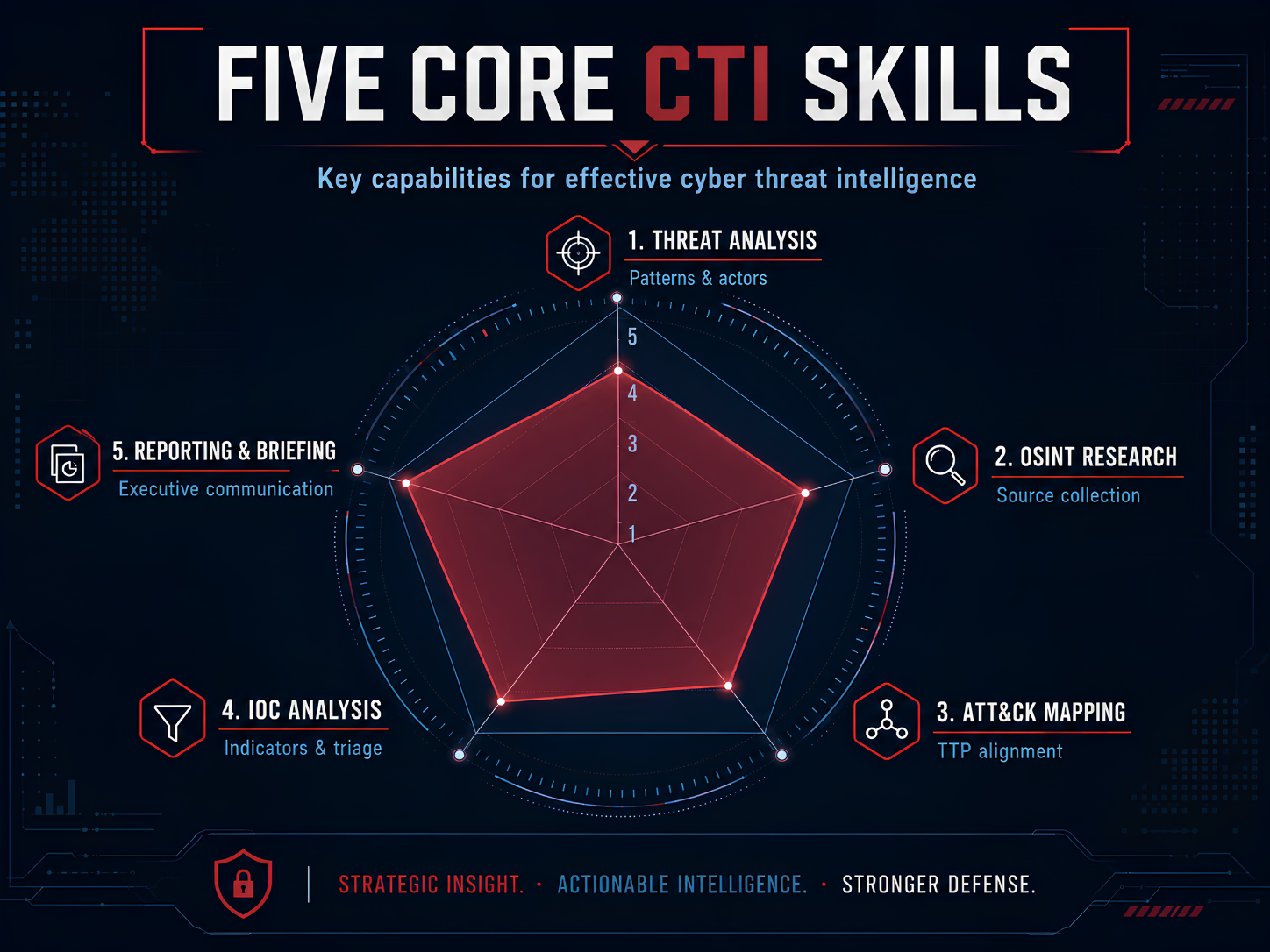
Job descriptions list twenty requirements. Most of them collapse into five real skills.
A technical foundation. You cannot analyze attacks against systems you do not understand. Networking (TCP/IP, DNS, HTTP), operating system internals for Windows and Linux, how logs are generated and where they live, and comfort reading them. You do not need to be a network engineer, but a threat report written by someone who does not understand how DNS tunneling works reads exactly like what it is.
Framework fluency. This is the part that separates people who sound like analysts from people who are analysts. You need to think in MITRE ATT&CK, and SOC hiring managers consistently name ATT&CK fluency as the differentiator that gets candidates hired. Add the Diamond Model of Intrusion Analysis for structuring what you know about an intrusion, the Cyber Kill Chain for phase-based thinking, and the Pyramid of Pain for understanding which indicators actually cost an adversary something to change. These are not academic. They are the shared language of the field.
OSINT and collection skills. Knowing how to find things. Pivoting from a single domain to an actor's full infrastructure using tools like Shodan and Censys, tracking handles and personas, understanding where and how attackers advertise and sell. This is the collection half of the discipline, and it is a genuine craft. Read our complete OSINT guide if you want to go deeper here.
Analytical writing. Here is the uncomfortable truth almost every guide skips. The bottleneck in becoming a good analyst is not learning tools. Tools take weeks. The bottleneck is producing enough analytical writing to develop judgment, and that realistically takes twelve to twenty-four months of consistent output. You have to be able to write a finished intelligence product that a stressed decision-maker can read in ninety seconds and act on. Structured analytic techniques, confidence language ("we assess with moderate confidence"), separating what you know from what you infer. If you cannot write, you cannot do this job, full stop.
Communication and judgment. The soft skills that hiring managers now rank above technical ability in survey after survey. Briefing an executive who does not speak in hashes. Knowing when your evidence is thin and saying so. Being right often enough to be trusted, and honest enough to admit when you are not.
The Roadmap: Step by Step
Enough context. Here is the sequence that actually gets you there. It is deliberately ordered. Skipping steps is the most common way people stall.
Step 1: Build the Security Foundation
Before you touch anything labeled "threat intelligence," get the fundamentals solid. Networking, operating systems, basic security concepts. If you are starting from zero, this is where free training earns its keep. ISC2 currently offers its Certified in Cybersecurity (CC) with free training and an exam voucher, and the Google Cybersecurity Professional Certificate covers foundational ground at low cost. This stage takes a few months and it is not optional. Everything after this assumes it. Our introduction to information security is a good place to start if the fundamentals are new to you.
Step 2: Learn to Think Like an Analyst
Now layer in the intelligence mindset and the frameworks. Read the foundational thinking on the intelligence lifecycle, planning, collection, processing, analysis, dissemination, feedback. Internalize ATT&CK, the Diamond Model, and the Kill Chain until you can map a real breach to them without looking anything up. This is also where you learn structured analytic techniques, the methods intelligence communities use to fight their own bias. It is cheaper to learn these habits now than to unlearn sloppy ones later.
Step 3: Get Your Hands Dirty
Reading about threat intelligence makes you conversational. Doing it makes you employable. Build a home lab. Pull apart real, defanged samples. Practice OSINT investigations against real infrastructure. Run through CTF-style challenges that force you to pivot, correlate, and reach a conclusion under a little pressure. The goal is not to memorize; it is to build the reflex of turning scattered artifacts into an assessment.
This is exactly the gap CTI Academy's Hunter track was built to close. Rather than watching lectures, you work inside simulated environments: NullBase, a simulated underground forum where you practice the HUMINT and persona-tracking skills you can never rehearse on the live web without burning yourself; LeakLens, for working through credential leak and breach data the way an analyst actually does; and a SOC Simulator that puts you on the receiving end of alerts so intelligence stops being abstract. The point is repetition on realistic problems, which is the only thing that builds judgment.
Step 4: Learn to Write Intelligence, Not Summaries
Start producing finished products, and do it publicly if you can. Take a real recent campaign, research it, and write it up the way an analyst would: an assessment with a clear judgment up front, evidence underneath, confidence levels, and a "so what" for a specific reader. Then do it again next week. And the week after. This is the habit that separates people who get hired from people who keep applying. Writing is the muscle, and it only grows under load.
Step 5: Certify in the Right Order
Certifications open doors and validate skills, but chased in the wrong order they waste money. The order matters more than any single cert. Detailed breakdown is in the next section, but the short version: foundation first, specialization later, and do not start with the expensive gold-standard exam. It is designed for people who already have years of operational experience.
Step 6: Build a Portfolio That Proves Judgment
A certification says you passed a test. A portfolio shows you can think. Publish your write-ups on a blog or GitHub. Contribute to open-source projects like MISP. Document your investigations. When a hiring manager can read three of your assessments and see how your mind works, you stop being a resume and become a candidate. In a field where employers struggle to distinguish real analysts from people who collected indicators, demonstrated judgment is the strongest signal you can send.
Step 7: Get in the Door
Apply wide, and do not only apply to roles with "threat intelligence" in the title. Managed security service provider (MSSP) roles give newcomers exceptional breadth across industries and threat types, and they hire volume. SOC analyst roles are the classic on-ramp; take one, be visibly good at it, and pivot internally within a year. Target entry-level and junior postings honestly, lean on your portfolio to compensate for thin experience, and treat the first role as the beginning of the real education, not the finish line.
Certifications That Matter, and the Order to Take Them
Search "CTI certifications" and you get a wall of acronyms with no guidance on sequence. Here is the sequence, with the reasoning.
| Certification | Provider | Best for | Rough cost | Notes |
|---|---|---|---|---|
| Security+ | CompTIA | Absolute foundation | ~$400 | Often mandated for U.S. government and DoD roles. Two to four months of study. |
| CySA+ | CompTIA | Early analyst skills | ~$400 to $500 | Behavioral analytics, detection, response. A natural bridge toward intel. |
| BTL1 | Security Blue Team | Hands-on blue team | ~$500 | Practical, lab-heavy. A strong alternative or complement to CySA+. |
| CTIA | EC-Council | CTI specialization | From $1,069 with training (EC-Council iClass, Sep 2026) | Covers the full intelligence lifecycle. Vendor-neutral, ANSI accredited. Recommends around three years of experience or the coursework. |
| GCTI | GIAC (SANS) | Senior mastery | $999 exam attempt; SANS FOR578 course $8,780 (US, Sep 2026) | The gold standard. Proctored exam that includes CyberLive hands-on items. Not a starting point. |
The path most working analysts recommend runs Security+ into CySA+ or BTL1, then CTIA to formalize your intelligence skills, and finally GCTI once you are genuinely operating at a senior level. Completing that full progression, with the real-world experience you need between steps, realistically takes one to two years.
A few honest notes. The GCTI, tied to the SANS FOR578 course, is widely regarded as the best CTI credential in existence, and it is priced accordingly. Do not chase it early. It is built for practitioners with years of operational time behind them, and taking it before you have the basics is like applying for a PhD before you have finished high school. The CTIA is the sweet spot for someone transitioning into intelligence from a SOC or IR background: affordable, specialized, and it signals deliberate focus without a SANS-sized invoice. And remember that certifications open doors; they do not replace time in the operational world. No exam substitutes for knowing what an alert looks like in a real SOC at 3 a.m.
The Tools to Learn
You do not need to master all of these on day one, but you should recognize every name on this list and be comfortable with several.
For threat intelligence platforms and management, MISP and OpenCTI are the open-source workhorses; learning MISP in particular is a resume asset because so many teams run it. For adversary behavior, the MITRE ATT&CK framework and its Navigator are non-negotiable. For infrastructure investigation and pivoting, Shodan and Censys let you map an actor's footprint from a single indicator, and Maltego helps you visualize the links. For file and URL analysis, VirusTotal and urlscan.io are daily companions. Underlying all of it, comfort with a scripting language, usually Python, so you can automate the tedious parts of collection and enrichment.
Staying current is itself a skill, and the field moves weekly. Building a habit of reading frontline reporting from vendors like Mandiant, CrowdStrike, and Unit 42, and following curated intelligence feeds, keeps you sharp. CTI Academy's own news aggregator, todayincyber.io, exists partly for this reason, to keep the day's signal in one place instead of scattered across fifty tabs.
How Long Does It Really Take?
If you are starting with a basic technical foundation and you work at it consistently, plan on twelve to twenty-four months to become genuinely competent, not just certified. The gating factor is not the tools and not the exams. It is the analytical judgment that only comes from producing enough finished work to have been wrong, corrected, and better for it. Anyone promising you a job-ready CTI analyst in six weeks is selling something. The good news is that the demand is patient; the field will still be short of people when you are ready.
Common Mistakes That Keep People Stuck
A few patterns show up again and again in people who study for a year and still cannot break in.
The first is becoming an indicator collector instead of an analyst. Feeds are easy. Judgment is hard. If your entire skill set is gathering IOCs, you have automated yourself out of a job before you started, because that is exactly the work machines are absorbing.
The second is never writing. People consume endless reports and produce nothing. Employers cannot see your reading. They can see your writing. Publish.
The third is certification tunnel vision, treating a stack of acronyms as a substitute for demonstrable skill. A cert with no portfolio behind it is a weaker signal than a portfolio with no certs.
The fourth is ignoring the SOC. Analysts who have never seen the operational side write intelligence that operators cannot use, and hiring managers can smell it in an interview. Time in or near a SOC is not a detour from the CTI path. It is part of it.
Where CTI Academy Fits
Most CTI training falls into two camps: dense academic material that never touches a real tool, or vendor marketing dressed up as education. CTI Academy was built for the space in between, the practitioner's path.
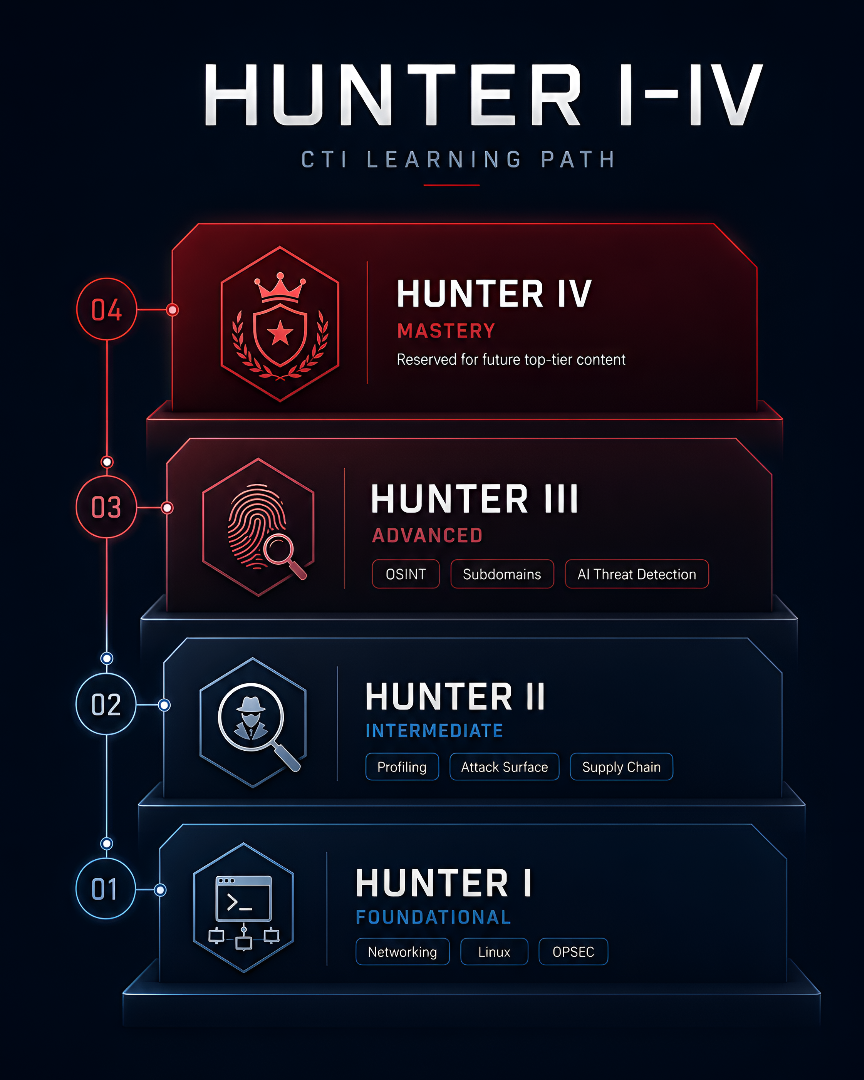
The Hunter track runs from Hunter I through Hunter IV, taking you from fundamentals to advanced tradecraft without skipping the hands-on middle where judgment is actually built. Instead of passive lectures, you work inside environments that mirror the real thing: NullBase for underground and HUMINT practice, LeakLens for breach and credential analysis, and a SOC Simulator that puts real alerts in front of you. It is the repetition-on-realistic-problems approach this whole guide has been arguing for.
If you are ready to stop reading about threat intelligence and start doing it, start with the Cyber Threat Intelligence learning path.
Frequently Asked Questions
Can I become a CTI analyst with no experience?
Not directly into a senior role, but yes into the field. The realistic path is to build a foundation, get hands-on practice, produce a portfolio of written analysis, and enter through an adjacent role such as SOC analyst or an MSSP position, then pivot into dedicated intelligence work within a year or two.
Do I need to know how to code?
You do not need to be a software engineer, but comfort with a scripting language, usually Python, is a strong advantage. It lets you automate collection and enrichment, which is a large part of the tedious work. You can enter the field without it and pick it up as you go.
What is the difference between a SOC analyst and a CTI analyst?
A SOC analyst monitors, triages, and responds to alerts inside an organization's own environment. A CTI analyst produces knowledge about adversaries, their tactics, their infrastructure, and their intent, which the SOC and leadership then use. The SOC is a common on-ramp into CTI because it teaches you the customer you will eventually write for.
Which certification should I get first?
CompTIA Security+ if you are starting from a general foundation, especially if you may want government or defense roles where it is often mandated. Do not start with GCTI; despite being the most respected CTI credential, it is designed for practitioners who already have years of operational experience.
How much does a cyber threat intelligence analyst earn?
Figures vary widely by source and title, but a reasonable 2026 U.S. picture is roughly $65,000 to $85,000 at entry level, $95,000 to $130,000 mid-career, and $130,000 to $175,000 or more at senior levels. The Bureau of Labor Statistics puts the median for information security analysts around $124,910. Pay is lower outside the U.S. but demand is strong across most mature markets.
Is threat intelligence a good career in 2026?
Yes. The global cybersecurity talent gap sits near 4.8 million roles, the Bureau of Labor Statistics projects 33 percent growth for information security analysts through 2034, and threat intelligence specifically is one of the faster-growing specializations. AI is raising the skill bar rather than replacing the role.
How long does it take to become a CTI analyst?
With a basic technical foundation and consistent effort, plan on twelve to twenty-four months to reach genuine competence. The limiting factor is developing analytical judgment through repeated real practice, not passing exams.