
Ask ten CISOs where they started, and eight of them will say some version of a security operations center. That single fact tells you most of what you need to know about how these two roles relate. SOC analyst and CTI analyst are not two ends of a fork in the road where you pick one forever. They are two seats on the same team, and one of them is the most common on-ramp to the other.
So the useful question is not "which is better." Both are real careers, both pay well, both are in demand. The useful question is which one fits the way your brain actually likes to work, and how the two connect over a career that might pass through both.
Here is the honest comparison, including the parts the recruiter pages leave out: the salary reality behind wildly inconsistent job titles, the burnout that drives a large share of SOC analysts to plan their exit within eighteen months, and what AI is quietly doing to the entry level of both jobs.
The One-Sentence Difference
A SOC analyst defends the organization right now, in real time. A CTI analyst researches who is likely to attack and how, and turns that into intelligence the SOC uses to know what to look for. Put the most simply: the SOC consumes threat intelligence, and CTI produces it.
Everything else, the tools, the pace, the salary bands, the mindset, follows from that one distinction. A SOC lives in minutes and hours. Threat intelligence lives in days and months.
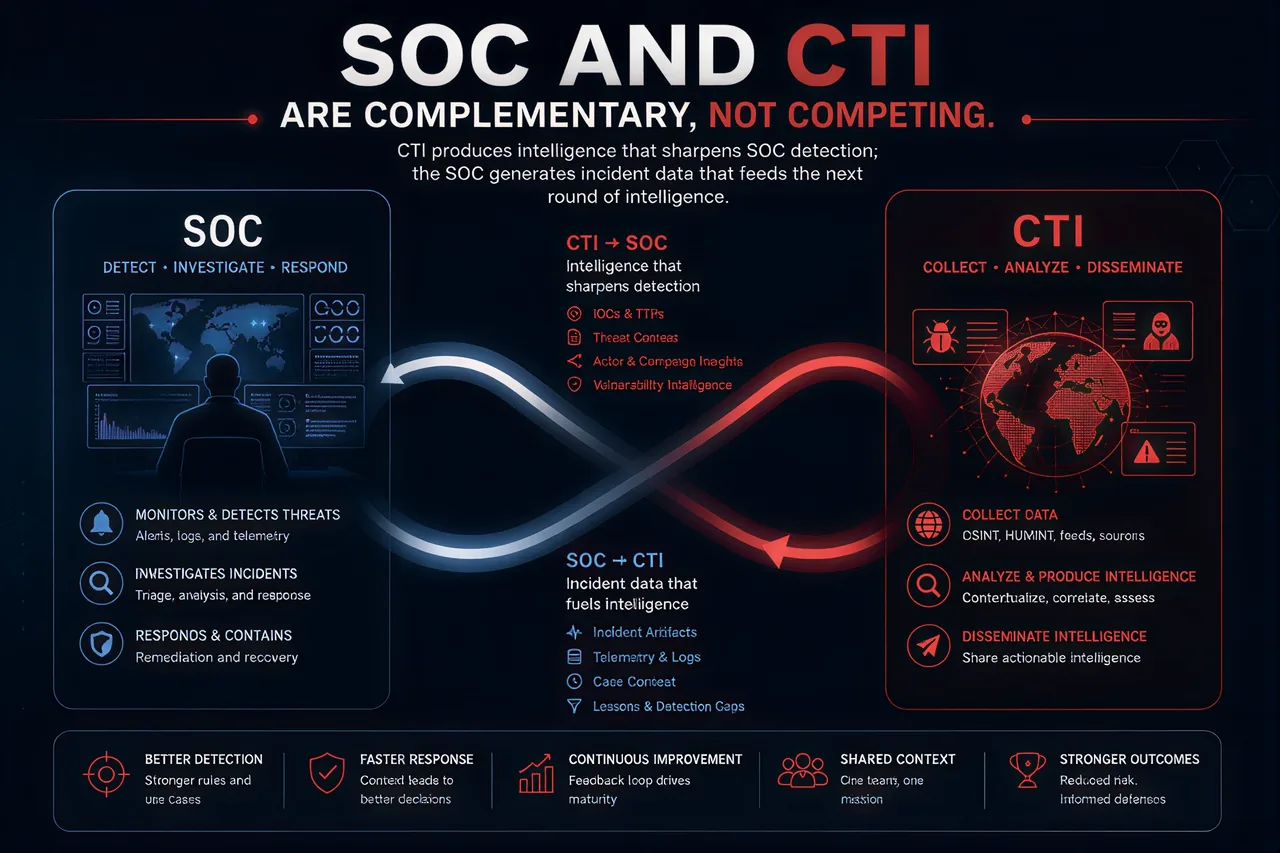
SOC and CTI are complementary, not competing. CTI produces intelligence that sharpens SOC detection; the SOC generates incident data that feeds the next round of intelligence.
What a SOC Analyst Actually Does
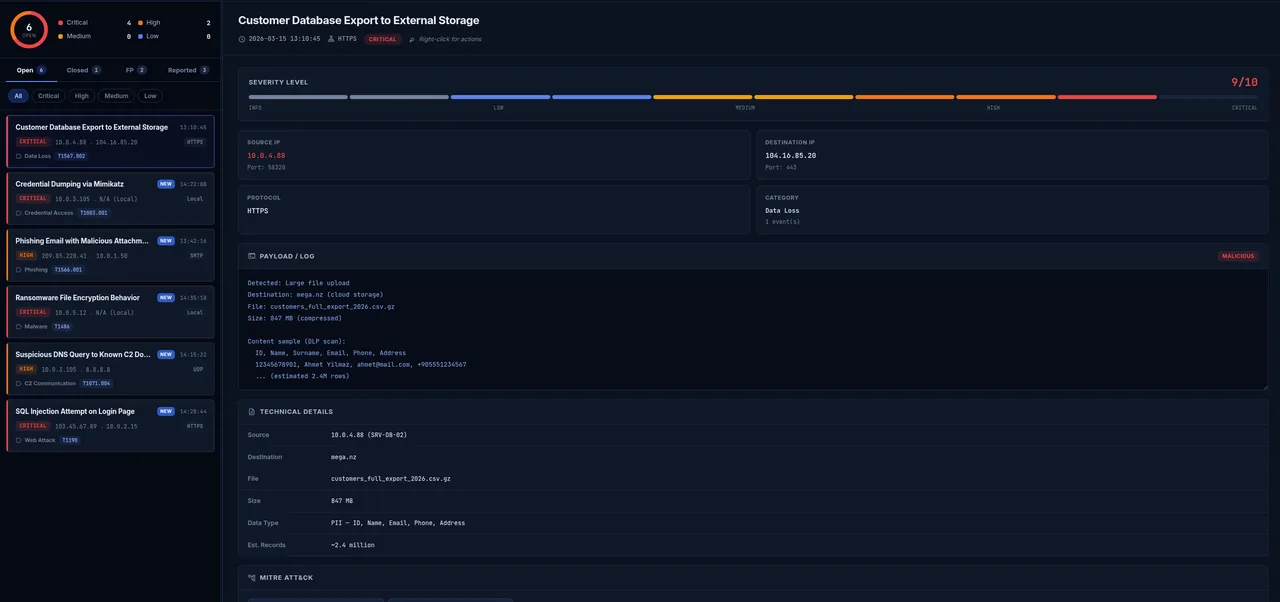
The SOC analyst is the front line of defense, and the work is fundamentally reactive. Something fires, you investigate. Day to day, that means triaging alerts from a SIEM platform, validating whether they are real, investigating potential incidents across EDR and network telemetry, and escalating or containing confirmed threats. It is fast, detail-oriented, and often shift-based, because attacks do not keep office hours and many SOCs run 24/7. On a busy shift you might write fifty or more tickets.
The role is tiered, and understanding the tiers matters because "SOC analyst" covers an enormous range. Most SOCs run three or four tiers. A Tier 1 analyst monitors the alert queue, judges urgency, and handles the routine noise. A Tier 2 analyst takes the confirmed incidents, works out which systems are affected, and drives containment and recovery. A Tier 3 analyst handles the critical incidents and shades into threat hunting and detection engineering, proactively looking for what the alerts missed and building the rules so similar alerts auto-resolve next time.
The mindset the SOC rewards is speed under pressure. Every minute matters because the attacker may already be inside. The best SOC analysts make a confident triage call in ten minutes and are calm when the real incident lands at three in the morning.
What a CTI Analyst Actually Does
The CTI analyst steps back from the individual alert and asks the bigger questions: who is targeting organizations like ours, how do they operate, and what should we prepare for. Instead of reacting to alarms, the work is research. You profile threat actors and document their tactics, techniques, and procedures. You track campaigns and malware trends. You monitor threat feeds, security reporting, dark web forums, and intelligence-sharing communities for what is coming. And you turn all of it into finished products: enriching the SOC's alerts with context on who is likely behind them, writing threat reports pitched at audiences from analysts to the CISO, and feeding IOCs and TTPs into the SIEM and SOAR so defenses improve.
The output is intelligence, not containment. Where a SOC analyst produces tickets and timelines, a CTI analyst produces assessments, briefings, and the strategic context that helps an organization spend its security budget on the right things. The audience is broader too, spanning the SOC, incident responders, security architects, and executives.
The mindset CTI rewards is patience and synthesis. You might research a single threat actor for weeks to understand its motivations and typical patterns. Success is foresight, and it depends on connecting dots across large, messy datasets and then writing the conclusion clearly enough that a busy decision-maker can act on it. If the SOC analyst is a firefighter, the CTI analyst is closer to a detective, or to a meteorologist forecasting the storm rather than responding to it.
Head to Head
| Dimension | SOC Analyst | CTI Analyst |
|---|---|---|
| Focus | Now, internal | Future, external |
| Posture | Reactive | Proactive |
| Timescale | Minutes and hours | Days and months |
| Core output | Tickets, containment | Reports, assessments |
| Audience | Technical teams | SOC, architects, executives |
| Pace | Fast, shift-based | Research-paced |
| Core tools | SIEM, EDR, SOAR | TIP, OSINT, MISP, ATT&CK |
| Rewards | Fast decisions under pressure | Patience, research, writing |
| Entry difficulty | Most common entry point | Usually entered after some experience |
One thing the table cannot show is how much the two overlap in practice. Both are blue team. Both live and breathe MITRE ATT&CK. A good SOC analyst is already thinking like an intelligence analyst when they ask "who does this, and is this part of something bigger," and a good CTI analyst never loses sight of what the SOC can actually operationalize. The line between them is real, but it is a gradient, not a wall.
The Mindset Difference Is the Real Decider
Salary and demand are close enough between these roles that they should not be your deciding factor. The mindset should.
Choose the SOC if you are energized by real-time work, if you like the adrenaline of running toward the alarm, if you make decisions well under pressure, and if you learn best by doing rather than reading. The SOC will hand you a firehose of hands-on experience faster than anything else in security.
Lean toward CTI if you are the person who wants to understand the whole board, who enjoys research and reading, who can sit with an ambiguous problem for weeks, and who does not mind, or actively enjoys, writing up what you found. If real-time alert pressure sounds draining rather than exciting, that is a genuine signal, not a weakness.
Neither preference is more "advanced" than the other. They are different temperaments, and the field needs both.
Salary: An Honest Comparison
Here is where you have to be careful, because the numbers scatter and the reason is instructive: the title "SOC analyst" means completely different things at different companies. At one, a Tier 1 analyst is essentially an IT help desk worker staring at a dashboard. At another, they are reverse-engineering malware payloads. The pay reflects that range.
Using 2026 U.S. market data from Glassdoor, Coursera, and industry salary guides, a realistic picture looks like this:
| Role and level | Typical U.S. base range |
|---|---|
| SOC Analyst, Tier 1 | $55,000 to $95,000 |
| SOC Analyst, Tier 2 (incident responder) | $95,000 to $130,000 |
| SOC Analyst, Tier 3 (threat hunter / detection) | $130,000 to $160,000+ |
| CTI Analyst, entry | $75,000 to $90,000 |
| CTI Analyst, mid-level | $95,000 to $120,000 |
| CTI Analyst, senior | $140,000 to $180,000 |
A few honest notes on top of the numbers. CTI tends to start a little higher than Tier 1 SOC, partly because it is less often a true entry-level role. SOC pay accelerates sharply once you clear Tier 1, and the Tier 2 and Tier 3 bands overlap heavily with CTI. Certifications add real premiums on both sides, and shift differentials can meaningfully raise SOC pay for nights, weekends, and holidays. Both roles sit under the same healthy demand curve: the U.S. Bureau of Labor Statistics projects information security analyst roles to grow about 33 percent through 2034, far faster than the average occupation.
The Path Most People Actually Take
The single most common route into threat intelligence does not start in threat intelligence. It starts in the SOC.
There is a good reason hiring managers trust that path, and it is worth internalizing if you want a CTI career. The SOC teaches you what an alert actually looks like at three in the morning, how incidents escalate, and what real attacker behavior looks like in real logs. That experience is exactly what makes CTI work credible, because a threat intelligence analyst is ultimately writing for the SOC. If you have sat in that chair, you understand your customer. As one career guide put it, you learn more in eighteen months of Tier 1 SOC work than most cybersecurity degree programs cover in four years. That is only a slight exaggeration.
Two caveats keep this honest. First, the SOC is not the only door into CTI. People also arrive from OSINT and research backgrounds, from military or government intelligence, from incident response, and occasionally straight from strong self-directed study and a portfolio. Second, CTI is not simply "senior SOC." It is a lateral discipline with its own craft of analysis and writing, not a rung you automatically reach by surviving the SOC long enough. The move from SOC to CTI is a change of job, not just a promotion.
The Honest Warning: SOC Burnout Is Real
If you are considering the SOC as your entry point, and you probably should, you need to hear this part clearly, because most recruiter pages skip it.
SOC burnout is well documented and significant. The 2025 ISC2 Cybersecurity Workforce Study found that 48 percent of cybersecurity professionals feel exhausted trying to keep up with threats. In the SOC specifically, a widely cited Tines survey put burnout at 71 percent in 2022 and still 63 percent in 2023, and a large majority of respondents said they spent more than half their working hours on tedious manual tasks. Turnover follows: many SOCs cycle through Tier 1 analysts in under eighteen months, and a striking share of analysts report actively thinking about quitting. The causes are consistent, namely alert fatigue, 24/7 shift work, and repetitive low-value tasks.
The takeaway is not "avoid the SOC." It is to treat Tier 1 as a launchpad, not a destination. The standard, sensible advice across the field is to plan your move out of Tier 1 within twelve to twenty-four months, either up into Tier 2 and Tier 3, or laterally into CTI, detection engineering, incident response, or threat hunting. The analysts who stay in Tier 1 for five years or more often find their skills plateau while their peers who moved on kept growing. Go in with your eyes open, extract the enormous learning the SOC offers, and have a plan for the next step before you need it.
How AI Is Reshaping Both Roles
AI is changing the entry level of both jobs, and understanding how helps you aim.
In the SOC, automation is absorbing exactly the work that drives burnout. AI-assisted triage and SOAR platforms are cutting Tier 1 workload by roughly a fifth and reducing unnecessary escalations, which means Tier 1 analysts are increasingly expected to handle more complex triage from day one. The effect on pay is real: entry-level SOC salaries are compressing slightly, while demand and compensation rise for the Tier 2 and Tier 3 specialists who can manage AI-driven detection and handle the incidents machines cannot. The bottom of the pyramid is being automated; the value is moving up.
In CTI, the pattern rhymes. AI accelerates collection and processing, parsing feeds and enriching data at a scale no human team can match, but the judgment at the core of the work, weighing conflicting evidence, understanding an adversary's intent, and communicating uncertainty responsibly, stays human. In both roles, the mechanical floor is being automated and the analytical ceiling is rising. That makes the ability to upskill the single most valuable career asset you have, and it makes lingering at the automatable entry level the biggest risk.
How to Choose
Strip it down to a few honest questions.
Choose the SOC first if you want the fastest, broadest hands-on entry into security, you make decisions well under pressure, and shift work does not scare you off. It remains the most logical starting point for most people, and it opens doors to everything else.
Aim for CTI if research, writing, and big-picture pattern-finding are what genuinely engage you, and real-time firefighting does not. You can target it directly with the right background and portfolio, or reach it through the SOC, which is the lower-risk and more common route.
And hold both loosely. Neither is a dead end. A career that starts at a SOC keyboard can move into CTI, threat hunting, detection engineering, incident response, security engineering, or the management track toward CISO. The first role is a beginning, not a verdict.
Where CTI Academy Fits
CTI Academy's Hunter track is built to develop the threat intelligence analyst skill set specifically: the frameworks, the analytic tradecraft, the writing, and the underground and adversary knowledge that turn a curious beginner into someone who can produce intelligence a SOC will actually use. If threat intelligence is where you want to end up, whether you are coming from a SOC or aiming straight for it, that is the path the Hunter track is designed for.
The operational, SOC-side reps are coming too. A SOC simulator and a phishing simulator are on the CTI Academy roadmap, and once they land they will let you practice the hands-on skills that sit on the other side of this comparison, working an alert queue and pulling apart a phishing lure, alongside the CTI tradecraft. If you want to build the intelligence half of the picture now and be ready for the operational half as it arrives, start with the Cyber Threat Intelligence learning path.
Frequently Asked Questions
What is the difference between a SOC analyst and a CTI analyst?
A SOC analyst defends the organization in real time, triaging alerts from a SIEM, investigating incidents, and containing threats as they happen. A CTI analyst researches threat actors, campaigns, and techniques, then produces intelligence that tells the SOC what to look for. The SOC consumes threat intelligence; CTI produces it.
Is a CTI analyst better than a SOC analyst?
Neither is better; they are different roles for different temperaments. The SOC suits people who thrive on fast, real-time decisions and hands-on response. CTI suits people who prefer research, writing, and long-horizon pattern analysis. Both are in demand, both pay well, and many careers pass through both.
Do you need to be a SOC analyst before becoming a CTI analyst?
No, but it is the most common and lowest-risk path. SOC experience teaches you how alerts, incidents, and real attacker behavior look in practice, which is exactly what makes CTI work credible since you are writing for the SOC. People also enter CTI from OSINT, research, military intelligence, incident response, or strong self-study with a portfolio.
Which pays more, a SOC analyst or a CTI analyst?
They overlap heavily. Entry-level CTI often starts a little higher than Tier 1 SOC ($75,000 to $90,000 versus roughly $55,000 to $95,000), but SOC pay accelerates fast past Tier 1, and senior SOC threat hunters and senior CTI analysts land in similar six-figure bands. Title inflation means the SOC range is especially wide.
Is SOC analyst a good entry-level job despite the burnout?
Yes, with a plan. The SOC offers unmatched breadth of hands-on learning fast, which is why most security careers start there. But burnout is real, with SOC surveys reporting exhaustion rates well above half, so the sensible approach is to treat Tier 1 as a twelve-to-twenty-four-month launchpad and move up or laterally before it wears you down.
Can you move from SOC analyst to CTI analyst?
Yes, and it is one of the most common transitions in security. Build threat intelligence skills on the side, frameworks like MITRE ATT&CK and the Diamond Model, OSINT, and analytic writing, produce a portfolio of written analysis, and use your SOC experience as the credibility that shows you understand the intelligence consumer.
Will AI replace SOC and CTI analysts?
No, but it is reshaping both. Automation is absorbing routine Tier 1 SOC triage and accelerating CTI collection and processing, which compresses the entry level and shifts value toward analysts who can interpret, direct, and validate what the tools produce. The mechanical floor is being automated; the analytical work is becoming more valuable.
Sources
- ISC2: 2025 Cybersecurity Workforce Study
- Coursera: SOC Analyst Salary: Your 2026 Guide
- Vectra AI: SOC analyst: roles, skills, salary, and career guide
- U.S. Bureau of Labor Statistics: Information Security Analysts, Occupational Outlook Handbook
- Elastic: SOC analyst vs. security analyst: What's the difference?