
Here is a problem no salary guide likes to admit. In 2026, the exact same job title, cyber threat intelligence analyst, is listed at an average of $80,000 by one reputable source and $216,000 by another. Both are current. Both are for the United States. Both claim to describe the same role.
That is not a rounding error, and it is not one of them being wrong. It is the whole reason a good salary guide has to do more than quote a number. If you walk into a negotiation armed with a single figure you found on the first page of Google, there is a decent chance you are either lowballing yourself by fifty thousand dollars or pricing yourself out of a job that pays exactly what it should.
So this guide does two things. It gives you real, current, global salary ranges for threat intelligence analysts, across the United States, the UK, Europe, India, the Middle East, Singapore, and Australia. And more importantly, it teaches you to read those numbers, because the skill of understanding why they disagree is worth more than any of them individually.
Why CTI Salary Numbers Disagree So Wildly
Before a single figure, understand the four reasons the sources fight each other. This is the part that makes you hard to underpay.
Base salary versus total compensation. This is the biggest one. Some sources report base pay only. Others report total compensation, which folds in bonus, profit sharing, and sometimes equity. For a mid-career analyst, that difference alone can be thirty to fifty thousand dollars. When Salary.com says $80,000 and Glassdoor says $158,738, they are not describing different jobs. They are describing base pay and total pay for a similar job.
Title inflation. "Threat intelligence analyst" is one of the least standardized titles in security. At one company it means a junior analyst who mostly reformats vendor feeds. At another it means a specialist who reverse-engineers malware and briefs the board. The same words cover a two-to-one pay range, and no aggregator can tell which company you are looking at.
How the data was gathered. Job-ad scrapers like ITJobsWatch report what employers advertise. Self-reported platforms like Glassdoor and Levels report what employees say they earn, which skews toward people who feel good about their pay. Modeled estimates like SalaryExpert blend surveys and government data. Each method has a different bias baked in.
Sample size and seniority mix. Some of these figures rest on a few dozen data points. A handful of senior analysts in the sample can drag an "average" up dramatically, which is exactly why the senior-weighted Glassdoor number looks so high.
The practical takeaway is one sentence: always ask what a salary number includes and where it came from before you trust it. With that lens, the numbers below become useful instead of confusing.
United States Salary (the Anchor Market)
The US is where the data is deepest and the spread is widest, so it is the best place to see the method in action. Here is how the major sources price the role in 2026.
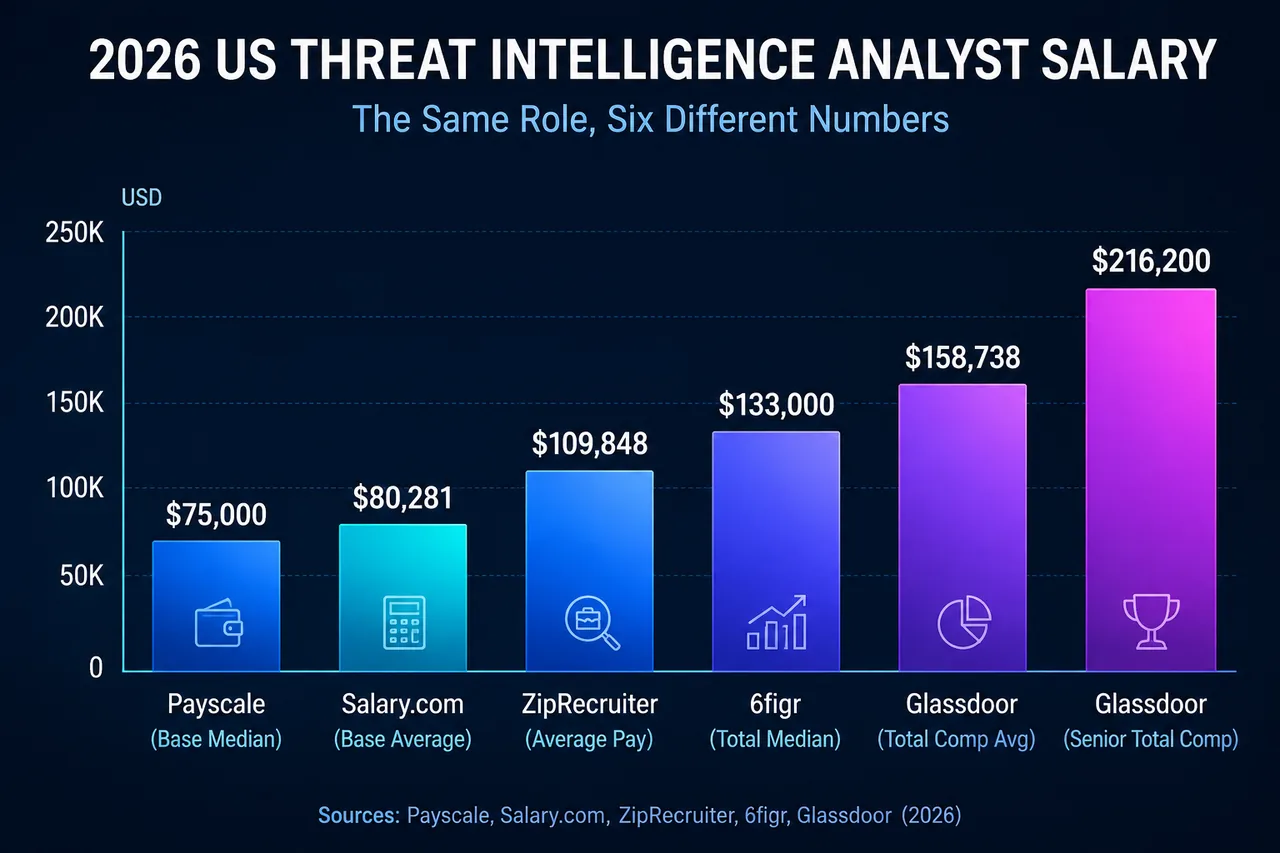
The same US role, priced six different ways in 2026. Most of the gap comes down to base salary versus total compensation, plus title and seniority.
| Source | 2026 figure | What it measures |
|---|---|---|
| Payscale | $75,000 | Base median |
| Salary.com | $80,281 | Base average |
| ZipRecruiter | $109,848 | Average pay |
| 6figr | ~$133,000 | Total, median |
| Glassdoor | $158,738 | Total compensation, average |
| Glassdoor (senior) | $216,200 | Total compensation, senior |
Read together rather than in isolation, they tell a coherent story. Reconciled into a realistic picture by seniority, US threat intelligence analyst pay in 2026 looks roughly like this:
| Level | Experience | Realistic US base range |
|---|---|---|
| Entry / Junior | 0 to 2 years | $70,000 to $95,000 |
| Mid-level | 3 to 5 years | $95,000 to $130,000 |
| Senior | 6 to 10 years | $130,000 to $175,000 |
| Lead / Principal | 10+ years | $175,000 to $220,000+ |
Two details worth knowing. The highest-paying sectors are consistently information technology and aerospace and defense, with Glassdoor putting IT median total pay around $148,000, and the most frequently named top payers include Recorded Future, Booz Allen Hamilton, and Northrop Grumman. And government roles, while often paying a lower headline number, frequently come with a security clearance that becomes one of the single biggest salary multipliers in the entire field, which we return to below.
Global Salary by Region
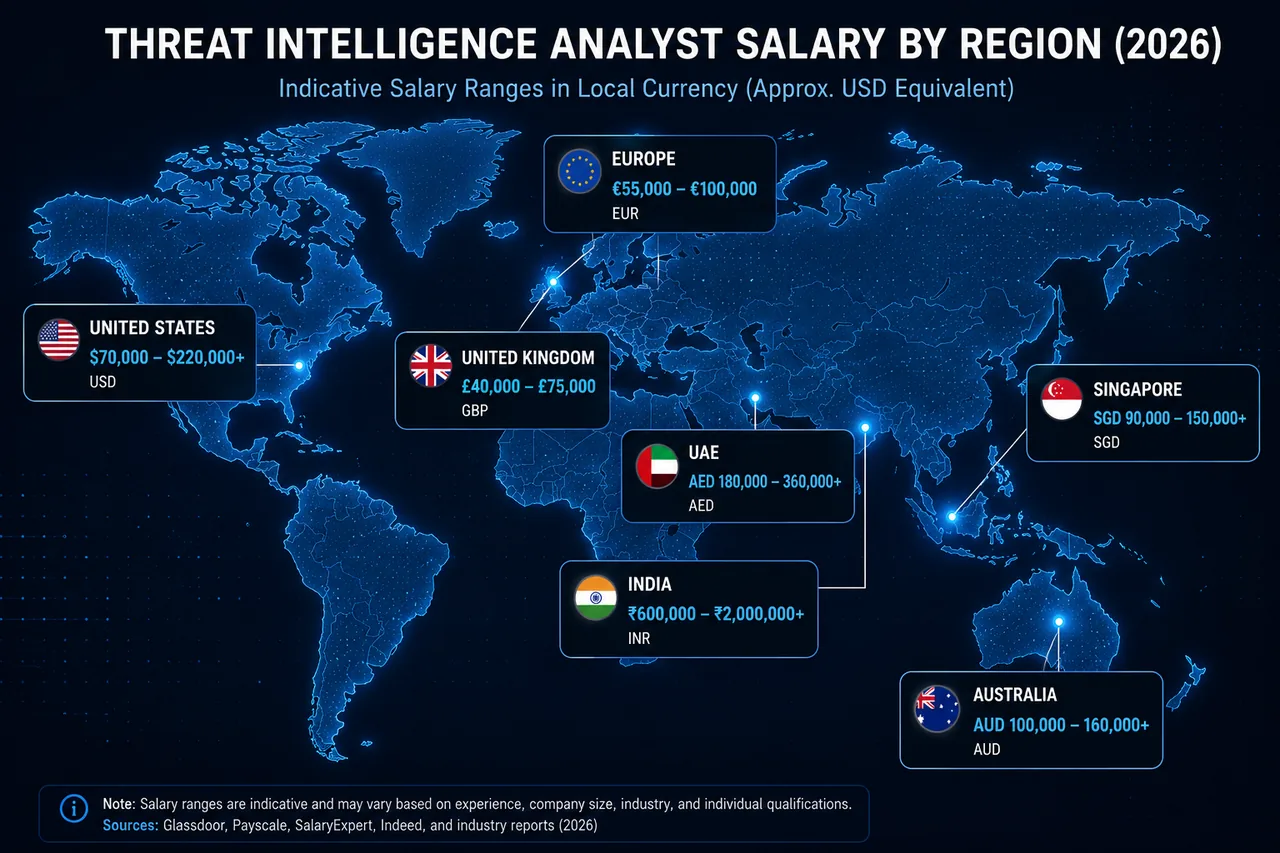
2026 threat intelligence analyst pay by region. The US and Singapore lead, Western Europe clusters in the middle, and India offers the fastest growth from a lower base.
Salaries fall sharply outside the US, but so does the cost of living, and in several markets the gap is smaller than you would expect once tax is accounted for. The table below shows indicative 2026 ranges in local currency, with an approximate US dollar equivalent for comparison. Treat the dollar figures as rough, since exchange rates move and these are not cost-of-living adjusted.
| Country | Entry | Mid-level | Senior | Approx. USD (mid) |
|---|---|---|---|---|
| United States | $70k to $95k | $95k to $130k | $130k to $175k | $95k to $130k |
| Singapore | S$90k to S$130k | S$150k to S$200k | S$200k to S$250k+ | ~$110k to $150k |
| Australia | A$100k to A$120k | A$120k to A$150k | A$150k to A$170k | ~$78k to $98k |
| United Kingdom | £55k to £75k | £75k to £105k | £100k to £135k | ~$95k to $133k |
| Netherlands | €55k to €75k | €75k to €105k | €100k to €135k | ~$81k to $113k |
| Germany | €52k to €72k | €72k to €100k | €95k to €128k | ~$78k to $108k |
| France | €50k to €68k | €68k to €95k | €90k to €122k | ~$73k to $103k |
| UAE | AED 130k to 180k | AED 180k to 260k | AED 260k to 310k+ | ~$49k to $71k (tax-free) |
| Poland | €35k to €52k | €52k to €75k | €72k to €98k | ~$56k to $81k |
| India | ₹8L to ₹16L | ₹16L to ₹26L | ₹26L to ₹40L+ | ~$19k to $31k |
A few regional notes that the table cannot carry.
Singapore is the standout, with Morgan McKinley's 2026 guide putting cyber threat intelligence pay at roughly S$150,000 to S$250,000, comparable to strong US numbers and reflecting the city's role as a regional security hub. The UK sits highest in Europe, with a market median around £65,000 across all levels per job-ad data, and senior specialists reaching £100,000 to £135,000, especially in London and financial services. Western Europe, meaning Germany, the Netherlands, and France, clusters closely together, with the NIS2 Directive and GDPR enforcement driving steady demand. The UAE pays less on paper, but the figures are tax-free, which materially changes take-home, and Gulf demand is rising fast. India offers the lowest absolute numbers, with a Bangalore average around ₹22 lakh, but the strongest growth trajectory and a booming market as global security operations centers expand there. Poland and Central Europe anchor the lower end of the EU while offering strong purchasing power locally.
Canada, which this table omits for lack of clean 2026 data, broadly tracks below the US and roughly with Australia, typically in the range of C$85,000 to C$135,000 depending on seniority and city.
What Actually Moves Your Salary
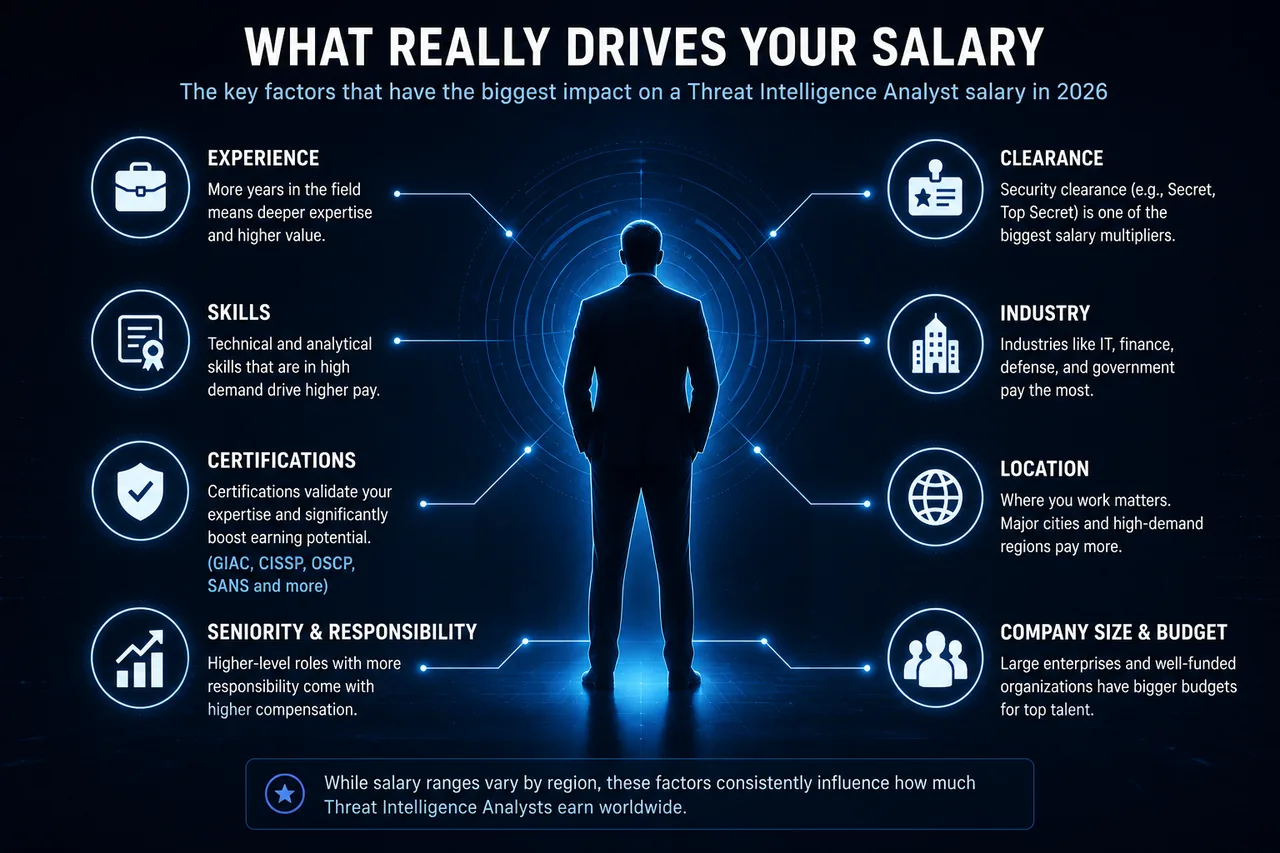
Seniority, sector, clearance, certifications, location, and job title: the six levers that explain most of the pay gap between two analysts with the same experience.
Location and title aside, a handful of factors explain most of the variation between two analysts with the same years of experience.
Seniority and the strategic ceiling. The clearest lever. Pay roughly doubles from entry to senior, and the analysts who reach the top bands are usually those who moved from tactical, indicator-level work into operational and strategic intelligence, briefing leadership and shaping security investment. Strategic capability is what unlocks the six-figure senior tier.
Sector. Defense, finance, and big tech pay a clear premium over retail, healthcare, and the public sector. If maximizing salary is the goal, the industry you choose matters as much as your skill.
Security clearance. In the US especially, an active clearance is one of the largest single multipliers available, because the pool of cleared analysts is small and the demand from government and defense contractors is constant. It can add a substantial premium on its own.
Certifications. The right credential signals specialization. The GIAC GCTI and EC-Council CTIA are the recognized threat intelligence certifications, but we have not found a reliable source that isolates how much either one adds to pay on its own, so treat any quoted certification premium with caution. A credential helps most when it is paired with demonstrable skill and a portfolio.
Location and remote work. Metro premiums are real, with San Francisco, Washington DC, London, and Singapore paying well above their national averages. Remote roles are quietly reshaping this, since an analyst in a lower-cost region working for a US company can capture much of the US premium without the US cost of living.
The title you negotiate. Because the role is so unstandardized, the words on your offer letter genuinely affect your pay and your next job's baseline. "Senior threat intelligence analyst" and "cyber intelligence analyst" can pay very differently for identical work.
Entry Versus Senior: The Trajectory
The shape of a CTI career is steep early and then branches. An entry-level analyst starts in the $70,000 to $95,000 band in the US and its equivalents elsewhere, doing hands-on collection, enrichment, and reporting. Within three to five years, competent analysts reach the mid tier around $95,000 to $130,000, and the ones who specialize, in the underground, in malware analysis, or in strategic assessment, pull toward the top of it.
The senior jump, into the $130,000 to $175,000 range and beyond, is less about time served and more about scope. It goes to analysts who own a domain, brief executives, and produce intelligence that changes decisions rather than just informing tickets. Above that sit lead and principal analyst roles, heads of threat intelligence, and eventually the management track toward CISO, where compensation leaves the analyst scale entirely. The ceiling in this field is high, but reaching it is a matter of developing judgment and specialization, not simply accumulating years.
Is It Worth It? The Demand Behind the Numbers
Salaries hold up in this field for a simple reason: there are not enough analysts. The global cybersecurity workforce gap sits near 4.8 million unfilled roles according to ISC2, and the US Bureau of Labor Statistics projects information security analyst roles to grow about 33 percent through 2034, far faster than the average occupation. Threat intelligence specifically is one of the faster-growing specializations within that. An undersupplied, high-demand field is one where salaries stay strong and negotiating leverage sits with the candidate, which is exactly the position CTI analysts are in heading through 2026. If you are weighing whether to enter the field at all, our guide on how to become a cyber threat intelligence analyst covers the path.
How to Increase Your CTI Salary
The levers above turn into a concrete plan.
Specialize rather than staying a generalist, because the premium tiers reward depth in the underground, in malware, or in strategic analysis. Earn a certification that actually signals that specialization. Target the sectors that pay, meaning defense, finance, and big tech. If you are in or near the US government market, seriously consider the clearance path for its outsized premium. Build a portfolio of written analysis that proves you operate at the level you want to be paid at, since demonstrated judgment is what justifies a senior offer. And be deliberate about location, whether that means moving to a high-comp metro or capturing a US salary remotely from a lower-cost base.
Underneath all of these is the same truth: pay in this field tracks capability and specialization, not tenure. The fastest way to move up the bands is to become genuinely better at the craft.
Where CTI Academy Fits
The salary bands in this guide are, in the end, a map of skill. The analysts in the top tiers are paid for tradecraft and specialization, and that is exactly what CTI Academy's Hunter track is built to develop, taking you from fundamentals into the underground, adversary, and analytic skills that command the higher ranges. The platform's NullBase environment lets you practice the underground and actor-tracking work that defines the well-paid specialist roles, and LeakLens puts you inside the credential and breach data those analysts work with daily. A SOC simulator and a phishing simulator are also on the CTI Academy roadmap, adding the operational reps that round out the skill set. If you want to build toward the higher end of these numbers rather than the lower, start with our learning paths.
Frequently Asked Questions
How much does a threat intelligence analyst make?
It depends heavily on location, seniority, and whether the figure is base salary or total compensation. In the US in 2026, a realistic base range is roughly $70,000 to $95,000 at entry, $95,000 to $130,000 mid-career, and $130,000 to $175,000 or more at senior level. Total compensation figures including bonuses run higher, which is why some sources report averages near $159,000.
Why do threat intelligence analyst salary figures vary so much?
Mainly four reasons: some sources report base pay while others report total compensation including bonuses, the job title is highly unstandardized and covers very different roles, data-gathering methods differ between job ads and self-reported surveys, and small sample sizes skew averages. Always check what a figure includes and where it came from.
What is the entry-level threat intelligence analyst salary?
In the US, entry-level roles typically pay $70,000 to $95,000 in base salary. In the UK, entry level runs around £55,000 to £75,000, in Western Europe roughly €50,000 to €75,000, in India about ₹8 to ₹16 lakh, and in Australia around A$100,000 to A$120,000. Location and sector cause wide variation.
Which country pays threat intelligence analysts the most?
Among major markets in 2026, the United States and Singapore pay the highest absolute salaries, with Singapore's cyber threat intelligence pay reaching S$150,000 to S$250,000 and senior US total compensation exceeding $200,000. Tax-free Gulf markets like the UAE are competitive on take-home despite lower headline figures.
Does a certification increase a threat intelligence analyst's salary?
It can help, but the effect is hard to measure. Recognized certifications like the GIAC GCTI and EC-Council CTIA signal specialization, yet we have not found a reliable source that isolates how much either one adds to pay on its own. Certifications matter most when paired with demonstrable skill and a portfolio, rather than on their own.
Do threat intelligence analysts earn more than SOC analysts?
Entry-level threat intelligence pay often starts slightly higher than Tier 1 SOC pay, but the two overlap heavily and senior SOC threat hunters can match or exceed CTI analysts. The bigger differences come from seniority, sector, and specialization rather than the role name. We compare the two paths in SOC analyst vs CTI analyst.
Can you earn a US salary as a remote threat intelligence analyst?
Increasingly, yes. Remote hiring lets analysts in lower-cost regions work for US-based companies and capture much of the US pay premium without the US cost of living. Competition for these roles is high, and they typically favor analysts with a strong portfolio, specialization, and a proven track record.
Sources
- ZipRecruiter, Cyber Threat Intelligence Analyst Salary
- Glassdoor, Cyber Threat Intelligence Analyst Salary
- Salary.com, Cyber Threat Intelligence Analyst Salary
- Optima Europe, Threat Intelligence Analyst Recruitment in Europe (2026 benchmarks)
- ITJobsWatch, Threat Intelligence Analyst salary (UK)
- Morgan McKinley, Cyber Threat Intelligence Salary Guide, Singapore 2026
- SalaryExpert, Threat Intelligence Analyst salary, India and UAE
- U.S. Bureau of Labor Statistics, Information Security Analysts, Occupational Outlook Handbook